·6 min read
1,000 Hours in Claude Code: What Finally Made It Click
After 1,000 hours in Claude Code, here's what flipped it from frustrating to indispensable: skills, hooks, MCP, and feeding it your ecosystem.
I almost quit Claude Code in the first week.
Five hours in, stuck on a Google auth loop. No progress. No working agent. Just me, a terminal, and a stack trace I didn't understand. I closed the laptop and told myself this was hype.
That was 1,000 hours ago.
Today, Claude Code runs my entire agency from one terminal window. Content, sales ops, deploys, scraping, client work. One tool. I rarely troubleshoot anymore. The work just flows.
Here's what actually changed between hour 5 and hour 1,000.

Infrastructure Is the Intelligence
The first lesson took me months to see.
Most people treat Claude Code like ChatGPT in a terminal. They open it, ask a question, copy the answer. That's leaving 80% of the tool on the table.
The model is the easy part. Anthropic ships the brain. Your job is to build the body around it.
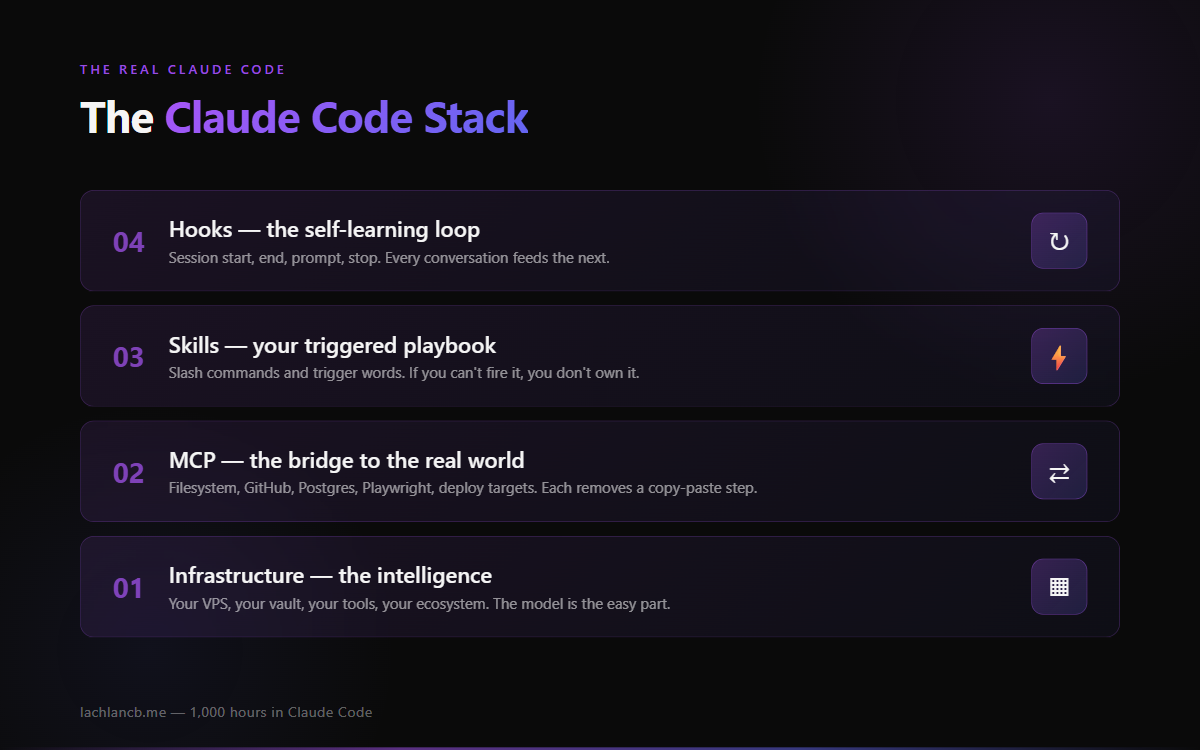
A VPS it can SSH into. A vault of context it can read. A folder of skills it can trigger. Hooks that fire on session start. Memory files that survive across conversations. Real tools, real files, real state.
Once I gave Claude my actual ecosystem — my VPS, my N8N stack, my Obsidian vault, my Stripe keys, my deployment patterns — every problem got smaller. The same model that couldn't fix a Google auth issue in week one now ships features in 20 minutes. Nothing changed about the model. Everything changed about the surface area I gave it.
Infrastructure is the intelligence. The smarter your environment, the smarter the agent looks.
Skills: Owning 500 Is Worthless Without a Trigger
I have over 500 skills installed. Most do nothing.
That's the trap. Power users collect skills like Pokémon cards. They watch a YouTube video, install ten more, never touch them. Six months later they have a skills/ folder the size of a small library and use four of them.
Skills only matter when they fire. That means one of two things:
- A clean trigger word ("blog draft", "vault quote", "weekly review") that maps to the skill
- A manual slash command you actually remember to run
If you can't say in one sentence when a skill should activate, delete it. I went through my 500 skills and audited every one. Tier 3 — anything I hadn't used in 30 days and couldn't explain — got archived. The remaining set is small, sharp, and load-bearing.
Rule: A skill you can't trigger is a skill you don't own.
MCP: The Bridge Between the Brain and the World
MCP servers are how Claude Code touches reality.
Without MCP, the agent is a smart text generator. With MCP, it can pull a Notion page, query a Postgres table, scrape a site with Playwright, deploy to DigitalOcean, post to Slack, and read your Gmail. All in the same conversation.
My current stack: Filesystem, GitHub, Supabase, Playwright, Exa, DigitalOcean, Docker, Notion, Qdrant, GoHighLevel. Each one removes a copy-paste step. Each saved second compounds.
The mistake I made early was installing too many at once. MCP servers fight for context window. Pick five that map to your real workflow. Add more only when you hit a real wall. Production setups are about wiring, not collecting servers.
Hooks: The Self-Learning Loop
Hooks are the most underrated feature in Claude Code. They turn a tool into a system.
A hook is a script that fires on an event — session start, session end, tool use, prompt submit. Claude doesn't run them. The harness does. Which means they happen even when the model forgets.
Here are the hooks I use daily:
- SessionStart — pulls my last session summary, my active project, my Mem0 memories, and injects them as context. I never re-explain what I'm working on.
- SessionEnd — auto-commits and pushes my dev workspace. Three private repos, fully backed up, zero manual git.
- UserPromptSubmit — injects relevant project context based on keywords in my message. If I mention a partner's name, his CRM file loads automatically.
- Stop — extracts memories from the conversation and writes them to Qdrant. Next session starts smarter than this one ended.
That last one is the self-learning loop. Every conversation feeds the next. The system gets sharper without me lifting a finger.
Patience: The Part Nobody Wants to Hear
Here's the part that doesn't fit on a Twitter thread.
Claude Code was hard at the start. Genuinely hard. Auth loops, broken hooks, MCP servers that wouldn't connect, skills that fired at the wrong time, context windows blowing up. I spent days on problems that now take me five minutes.
I almost gave up at hour five. I'm glad I didn't.
The curve is brutal at the start and exponential after. The first 100 hours feel like wasted time. The next 900 are the highest-leverage hours I've ever put into any tool.
If you're 10 hours in and frustrated, you're not doing it wrong. You're doing it on schedule. Keep going.
FAQs
How long does it take to get good at Claude Code?
Around 100 focused hours to feel competent. By 300 hours, it replaces most of your manual workflow. Past 500 hours, you stop seeing it as a tool and start seeing it as your operating system.
Do I need to know how to code to use Claude Code?
No, but you need to be willing to learn the surface area: terminals, file paths, env variables, SSH. Claude handles the actual code. You handle the wiring.
What's the single biggest unlock?
Feeding it your full ecosystem. Once Claude knows your VPS, your vault, your tools, and your conventions, it stops being a generic assistant and becomes your specific assistant.
Are skills, hooks, and MCP worth the setup time?
Yes — but only if you actually use them. A skill you never trigger is dead code. Build slow. Audit often.
What should beginners ignore?
Plugin collections, skill marketplaces, and "top 50" lists. Start with five MCPs, two hooks, and one custom skill. Add more only when you hit a real ceiling.
The 1,000-Hour Lesson
The tool isn't the breakthrough. The infrastructure around the tool is.
You don't need a smarter model. You need a smarter environment. Skills that fire. Hooks that remember. MCPs that touch the real world. A VPS that runs while you sleep. A memory system that learns from every conversation.
That's the real Claude Code. And it's worth every one of those frustrating early hours.
If you're at hour five and ready to quit — give it 95 more. Then we'll talk.
Want my exact Claude Code stack — skills, hooks, MCP servers, and the full agency setup? Book a 30-min AI discovery call and I'll walk you through it.