The whole thing, in five stops
You most likely got here from a QR code or a link I sent you. Rather than explain what I do, this walks you through it — the knowledge base, the systems I run my life on, what I'm building right now, and what I've tested and failed at. About four minutes, and every stop opens the real thing rather than a summary of it.
Everything I know, as a map
I keep a private knowledge vault — research, decisions, project notes, client work, diary. It's the substrate everything else on this site is built from, and it's the single best explanation of how I think, because it shows the shape rather than describing it.
The graph renders that vault as a live 3D constellation: every note a point, every connection a link, clustered by topic. The contents are anonymised and the sensitive folders are excluded entirely, so what you're seeing is the structure — genuinely tangled, not a tidied-up version.
- 1001
- notes
- 3487
- links
- 29
- topics
 Open the graph
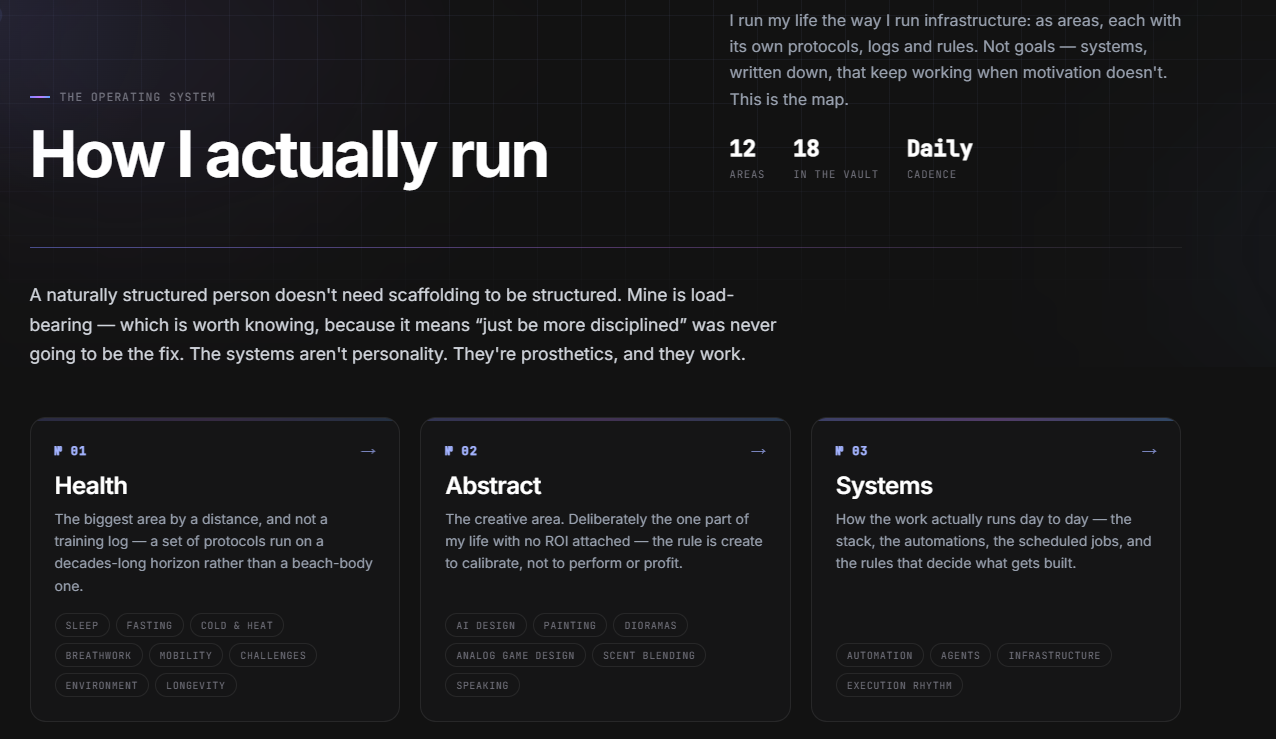
How I actually run
I run my life the way I run infrastructure: as areas, each with its own protocols, logs and rules. Not goals — systems, written down, that keep working when motivation doesn't.
There are twelve of them. Health is the largest by a distance and reads more like an engineering document than a wellness page. The governing rule across all of it is that the protocol gets published and the results don't — how I approach sleep is something anyone can copy, my bloodwork is a medical record.
- 15
- areas
- 13
- health protocols
- Daily
- cadence
 Open the system
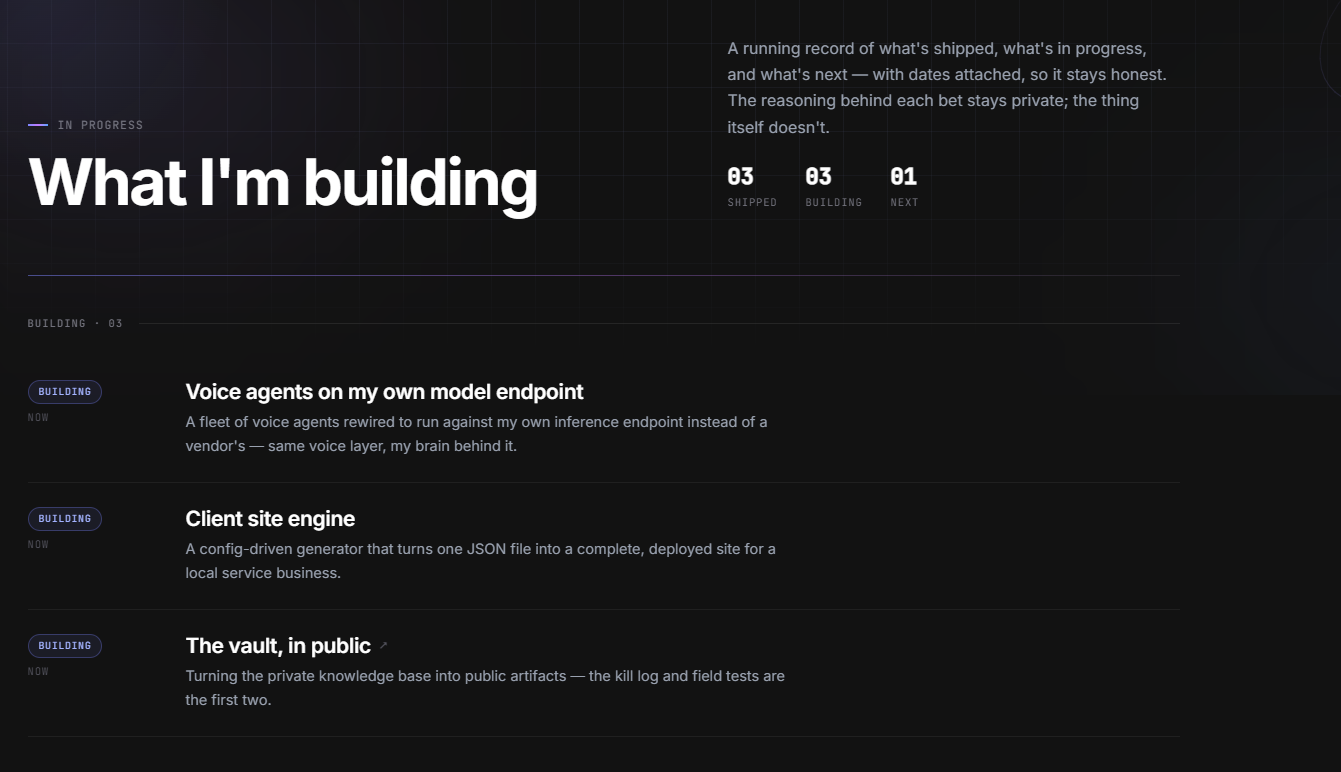
What I'm building
A running record of what's shipped, what's in progress, and what's next — with dates attached, which is the part that keeps it honest. The reasoning behind each bet stays private; the thing itself doesn't.
If you're trying to work out whether I can actually build the thing you need, this page and the tools page answer that faster than a case study would.
- 03
- shipped
- 03
- building now
- 66
- posts written
 See what's live
What I tested, including the failures
Experiments I actually ran, with the numbers that came back — including the ones that returned nothing at all. One campaign was roughly five thousand emails and a hundred texts for exactly zero replies, and that entry has more transferable information in it than any of the wins.
Alongside it sits the kill log: ideas I mapped, built or tested and then shut down, with the reasoning intact and what I kept from each. Anyone can publish the wins. The interesting question is what someone does with the other half.
- 06
- tests run
- 01
- outright failures
- 16
- ideas killed
 Read the results
Where to go from here
If you want the commercial version — what I sell and who it fits — that's the services page. If you'd rather just read, start with the writing. And if something here is directly relevant to a problem you have, a call is usually faster than email.

Point a phone at this
It opens this walkthrough. I built it because “so what do you do?” is a question I answer badly out loud and well in writing — so now I hold up a screen instead. Steal the idea if it's useful.