·7 min read
How to Scale a Digital Marketing Agency Without Hiring
How to scale a digital marketing agency with systems, not headcount: automate repeatable work, productize the offer, and let a personal brand bring clients.

Most agencies scale the same way. Land a client, assign someone to it, max out the team, hire. Repeat.
That model ties revenue to headcount. Every new client needs another pair of hands, every hire eats margin, and the founder ends up managing people instead of building the business.
If you're asking how to scale a digital marketing agency, the better question is how to raise what each person can carry. That's a systems problem, not a hiring problem.
I've worked with 10 clients across Thailand and Australia over four years. My own stack runs 16 services, 40+ workflows and 22 cron jobs. Here's the framework I use, and the part most agency owners skip: how to get clients once delivery can take them.
Why linear growth caps a marketing agency
Hiring feels like progress. It isn't always.
Each new person brings onboarding time, management overhead and another set of handoffs. The work that caps your capacity is rarely strategy. It's the admin around it: chasing approvals, building the same report every month, following up on leads, sending the same onboarding email for the fortieth time.
Add people to a messy process and you get a bigger messy process. Fix the process first and each person carries more.
You don't have a hiring problem. You have a leverage problem. Leverage comes from systems, not salaries.
How to grow a digital marketing agency without hiring
Four pillars. Each one removes manual work and raises how many clients one person can handle.
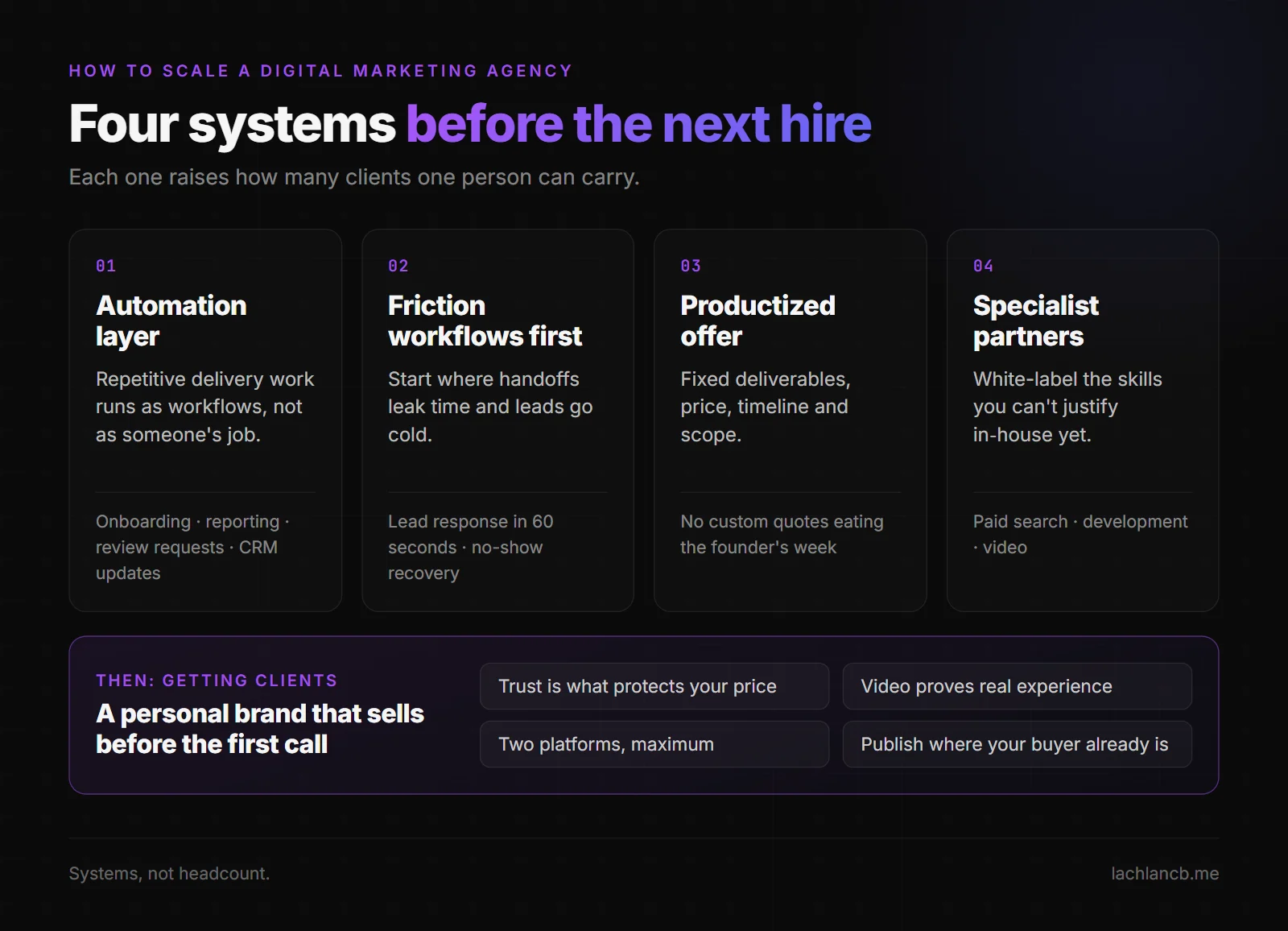
1. Build an automation layer for delivery
An automation layer is a set of workflows that handle the repetitive, high-volume work that used to need a person:
- Lead qualification and first response
- Client onboarding sequences
- Social scheduling and posting
- Review requests and replies
- Report data pulls and formatting
- Meeting notes and CRM updates
What this looks like in practice: a client signs. A workflow sends the welcome email, the intake form and the asset request, then chases whatever is missing. Their reporting is set up from a template. Nobody on your team starts from a blank page.
I run 22 cron jobs across my own infrastructure doing this kind of work: backups, health checks, reporting and alerts. None of it needs me to remember it. That is the whole point.
2. Automate the highest-friction workflows first
Not everything needs AI. Some of the biggest capacity drains are plain handoff problems: approvals, status updates, data moving from one platform to another.
Speed to lead is the clearest example. The MIT and InsideSales Lead Response Management study found the odds of qualifying a lead are 21 times higher when you contact it within five minutes rather than thirty. A Harvard Business Review audit of 2,241 US companies found the average first response took 42 hours, and 23% never responded at all.
A workflow that texts and emails every new lead inside a minute captures what competitors sleep through, with zero staff time.
Start here:
- Instant lead response (text and email within 60 seconds)
- Onboarding from signed contract to platform access
- Scheduled reporting that pulls, formats and sends itself
- No-show recovery (confirm, remind, nudge, rebook)
3. Productize your services
Custom scope and bespoke proposals are capacity killers. Every custom quote is hours of scoping, pricing and negotiating for a deal that may not close.
A productized service replaces that with a menu:
- Fixed deliverables
- Fixed price
- Fixed timeline
- A clear list of what's not included
The test: can a stranger read your offer and know what they get, what it costs and how long it takes? If not, you have a consulting engagement, and consulting scales linearly.
4. Partner for specialist work
Some skills you can't justify in-house yet. Paid search, development and video production are the usual ones. A white-label partner lets you deliver them under your brand without carrying the salary.
The shape that works: a lean core team for strategy and client relationships, automation for repeatable production, and partners for specialist work.
How to get clients for a digital marketing agency
Systems let you take more work. They don't bring it in.
If the pipeline depends on paid ads or cold outreach, growth is capped by your acquisition budget and your tolerance for rejection. The durable fix is a personal brand that sells before the first call.
Personal brand is the moat that's left
Your skill is replaceable. Your personal brand isn't. AI has collapsed the cost of most agency deliverables. What it hasn't collapsed is trust, and trust is what protects your price.
This isn't follower-chasing. It's positioning. The goal is for the right buyer to reach out before they've talked to a competitor. That comes from writing about real client situations, the things your buyer has tried that didn't work, and frameworks built from actual delivery.
Video is the fastest trust signal
Text builds authority. Video builds connection, and video is where the attention has moved.
- It's harder to fake. AI can write a post. Your face, voice and delivery are still yours.
- It proves experience. Walking through real work on screen shows what text can only claim.
- Platforms push it, because it keeps people on the platform longer.
Pick two platforms, where your buyer already is
Two platforms maximum. Trying to be everywhere is how you end up nowhere.
Choose them by where your buyer spends time, not where you enjoy posting. Agency owners selling to other businesses usually find their buyers on LinkedIn. Local service businesses are more often on Facebook and Instagram than on X. Distribution is the moat, and distribution means showing up where your buyer already pays attention.
A 90-day plan to scale your agency
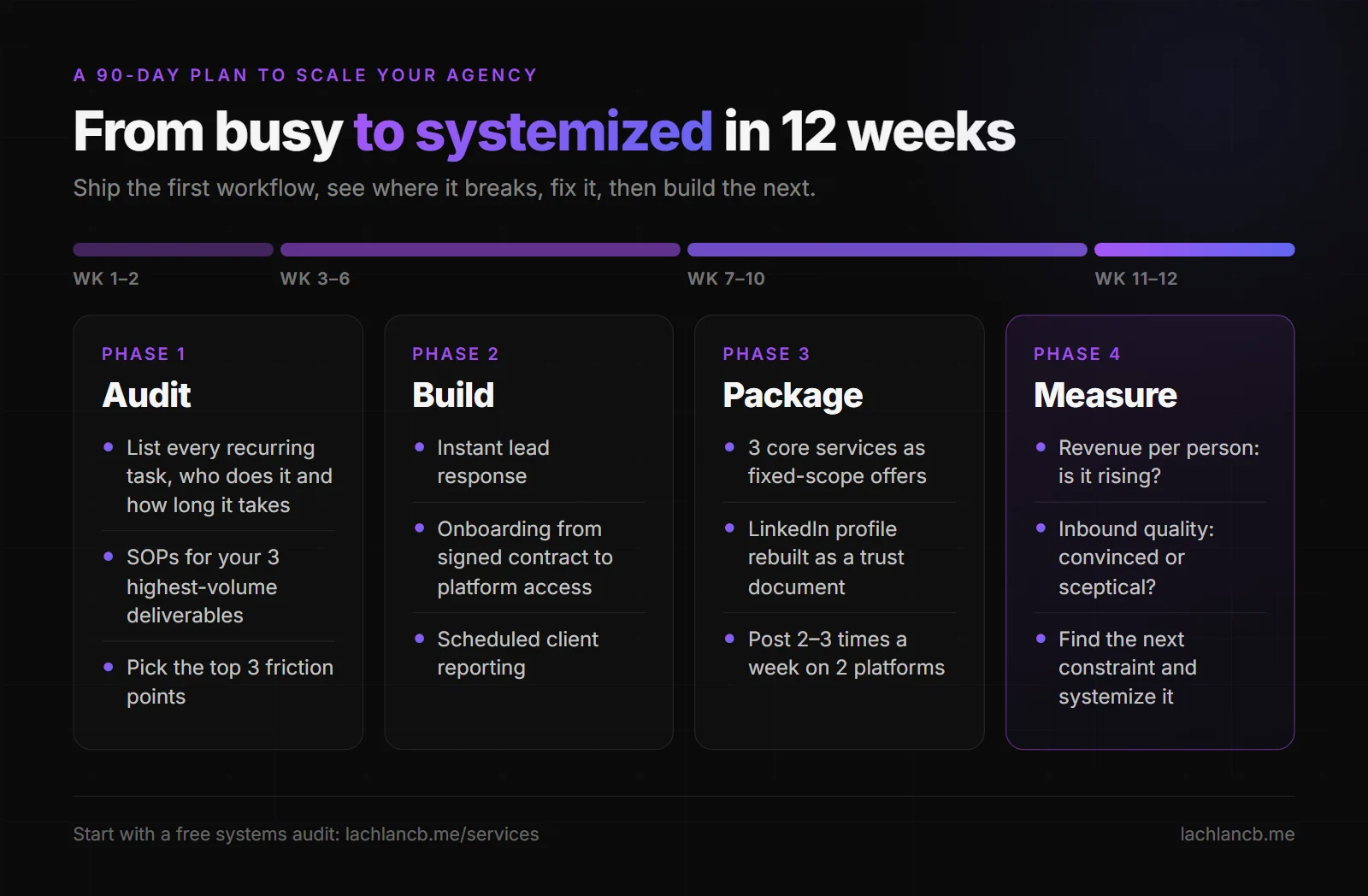
Weeks 1-2: Audit and document
- Run a systems audit: list every recurring task, who does it, and how long it takes
- Write SOPs for your three highest-volume deliverables
- Pick the top three friction points (reporting, onboarding and lead follow-up are the usual ones)
If you'd rather have a second pair of eyes on it, I run a free systems audit that does exactly this.
Weeks 3-6: Build the automation layer
- Instant lead response
- Onboarding from signed contract to platform access
- Scheduled client reporting
Weeks 7-10: Productize and position
- Package your three core services into fixed-scope offers
- Rebuild your LinkedIn profile as a trust document (headline, About, Featured)
- Post two to three times a week on your two platforms: real client situations, contrarian takes, frameworks from delivery
Weeks 11-12: Measure and iterate
- Track revenue per person. If it isn't rising, you're still scaling linearly
- Watch inbound quality: are buyers arriving convinced or sceptical?
- Find the next constraint and systemize it
Don't try to build the perfect system on day one. Ship the first workflow, see where it breaks, fix it, then build the next.
Systems and trust compound. Headcount doesn't.
Revenue tied to headcount is a ceiling. The way through is four moves:
- Build an automation layer for high-volume, low-judgement work
- Automate the highest-friction workflows first
- Productize the offer so scoping stops eating your week
- Use a personal brand, on two platforms, to bring in buyers who are already sold
Not sure which system to build first? Book a 30-min AI discovery call and I'll walk you through it.