·5 min read
Anyone Can Build Now. That's Why Selling Just Became Everything.
Building SaaS collapsed to near-zero. That didn't make selling easier — it made it the whole game. Why demand now gets filtered twice, and where the durable work actually is.
Building software used to be the hard part. You needed money, a team, months, and enough scar tissue to know what was even worth building. In 2026 that's gone. I can describe an app to Claude Code and watch it exist before my coffee's cold. So can you. So can the 19-year-old three timezones over who's never written a line of code.
That's the age of building. And almost nobody has thought through what it actually does to the people trying to sell what they build.
TL;DR: Building SaaS collapsed to near-zero, so the supply of products exploded. But selling never got easier — it got harder, because now your buyer can just build the thing themselves. Demand gets filtered twice: too many people selling, and too many buyers defecting to DIY. The durable, evergreen work isn't building anymore. It's selling — and helping the people who can build, sell.
The age of building is real
Five years ago, the bottleneck was technical. You needed someone who could code. Someone who could design a half-decent interface. Ideally a small team and a runway to pay them while they figured it out. The barrier to having a working product was real, and it kept a lot of people out.
That barrier didn't lower. It fell through the floor. Today the gap between "I have an idea" and "I have a working app" is a good prompt and an afternoon. The hard, expensive, gatekept part of the last decade is now the easy part.
Which sounds like great news. More people can make things. More ideas get to exist. And it is good — right up until you try to get someone to pay for what you made.
Building was never the moat
I wrote last week that the AI agency world is flooded with people selling the idea of selling AI, and I've argued before that distribution — not building — is the real moat. This is the same truth seen from the other side.
Here's the thing nobody wants to sit with: building was never the bottleneck. It just looked like it, because it was hard and visible and felt like the achievement. Shipping the product felt like crossing the finish line. It was never the finish line. It was the starting one.
Selling is a completely different skill from building, and it didn't get cheaper this decade. If anything it got more expensive — because the world it operates in just got a lot louder.
The twist nobody prices in: your buyer can build it too
This is the part that's genuinely new, and it's brutal if you're selling software.
It used to be that when you sold a SaaS tool, you competed with other SaaS tools. Now you also compete with your customer's own ability to build the thing. The question in their head isn't just "is there something cheaper?" It's "could I just… make this myself?"
And for a growing pile of small tools, the honest answer is yes. Why would they pay $40 a month for your dashboard when they can have an AI build a worse-but-mine version in an afternoon and own it outright? It's the same force that's quietly killing the subscription model. For deep, trusted, well-distributed products that question doesn't land. For the long tail of "I built a neat little tool" SaaS, it's lethal. Your buyer is now also your competitor.
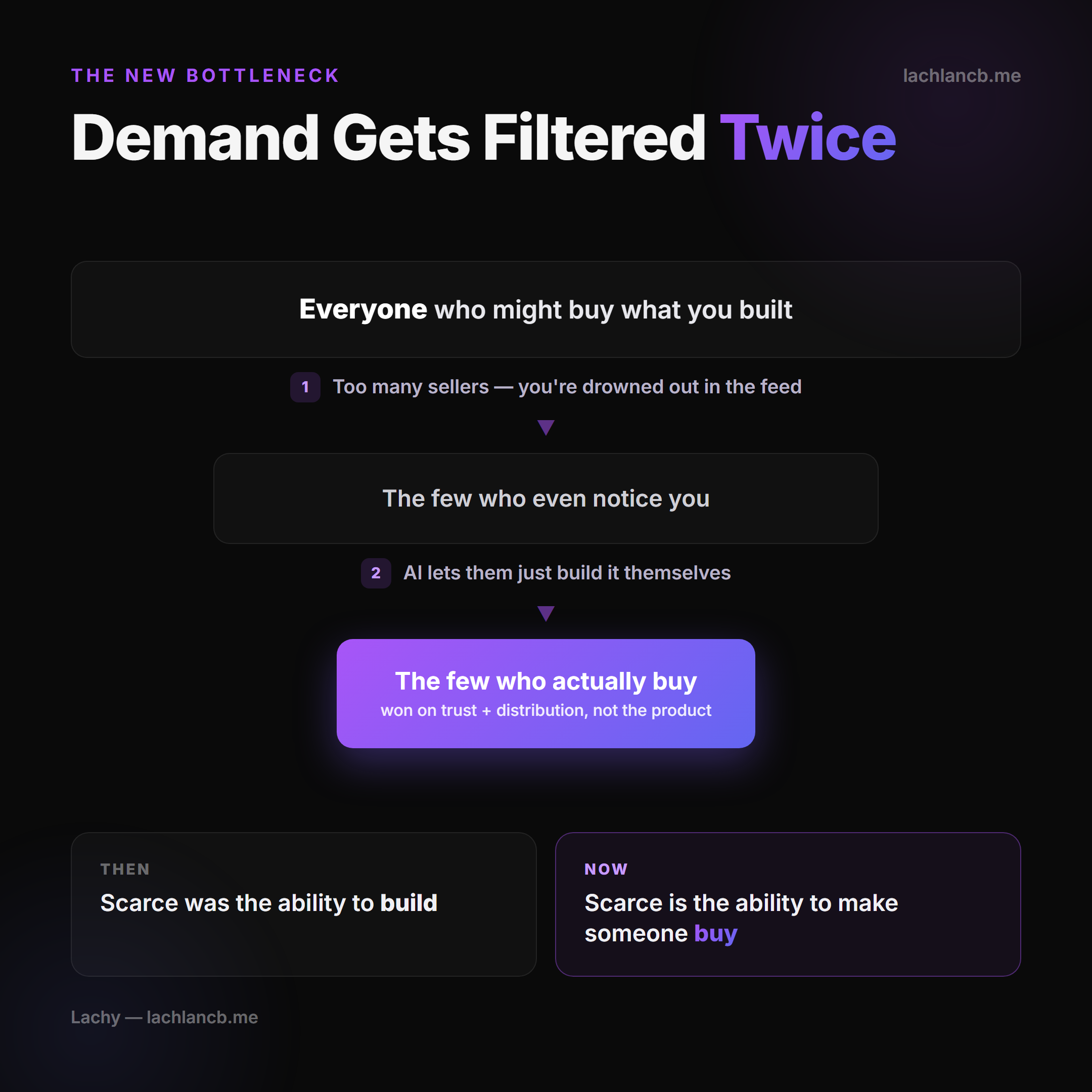
So demand gets filtered twice
Stack the two forces and you see the real picture.
On the supply side: everyone has something to sell. Every feed is full of people launching, shipping, posting their build. Attention was already scarce — now it's being fought over by an order of magnitude more sellers.
On the demand side: the buyers who are left can defect to building it themselves at any time.
If there's that much supply of people selling, it filters the demand. The product stops being the hard part. Getting someone to care — to notice you, trust you, and choose you over the silence or their own afternoon project — becomes the entire game. We've quietly moved from a world where the scarce thing was the ability to build, to one where the scarce thing is the ability to make someone buy.
Where the durable work actually is
I don't think this is bad news. It's the clearest signal in years about where to point your energy.
The people who win the next few years won't be the best builders. Building is table stakes now — everyone has it. They'll be the ones who can take something that's been built and put it in front of people who'll pay, and earn enough trust that the buyer doesn't just go build their own.
That's why I think the genuinely evergreen market now is selling — and helping the people who can build, sell. It's the same reason I keep saying sales is the last skill AI can't touch. Distribution. Trust. Attention. The unglamorous half of the equation that everyone skips because building is more fun and feels like progress. The half that was always the actual job.
So if you've built something and it's not selling, the instinct is to go back and polish the thing. Add a feature. Redo the landing page. Resist it. The product is probably fine. What's missing is the part nobody taught you to value, because for a decade it was hidden behind the hard part.
Stop polishing the thing. Start earning the attention. That's most of what I write about here — and most of what actually matters now. If that's the half you've been avoiding, stick around — it's most of what I write about.