Systems
A single-person operation designed to run most recurring work without active attention. One server, one knowledge vault, one interface I actually live in.
Systems covers how the work runs day to day. One server, one knowledge vault, one interface. It holds the stack, the automations, the scheduled jobs, and the rules that decide what gets built. Everything described here is in production, not planned.
Most productivity advice assumes you keep adding tools. I run the opposite direction. Narrow stack, understood completely, automated at the edges. Knowledge stored locally. Nothing depends on a third-party interface surviving. The real constraint was never capability. The server is a 2 GB box running about sixteen services. The constraint is maintenance. Scheduled jobs drift, documentation goes stale, and no amount of automation replaces the judgment calls. What follows is what actually runs, not what I originally designed.
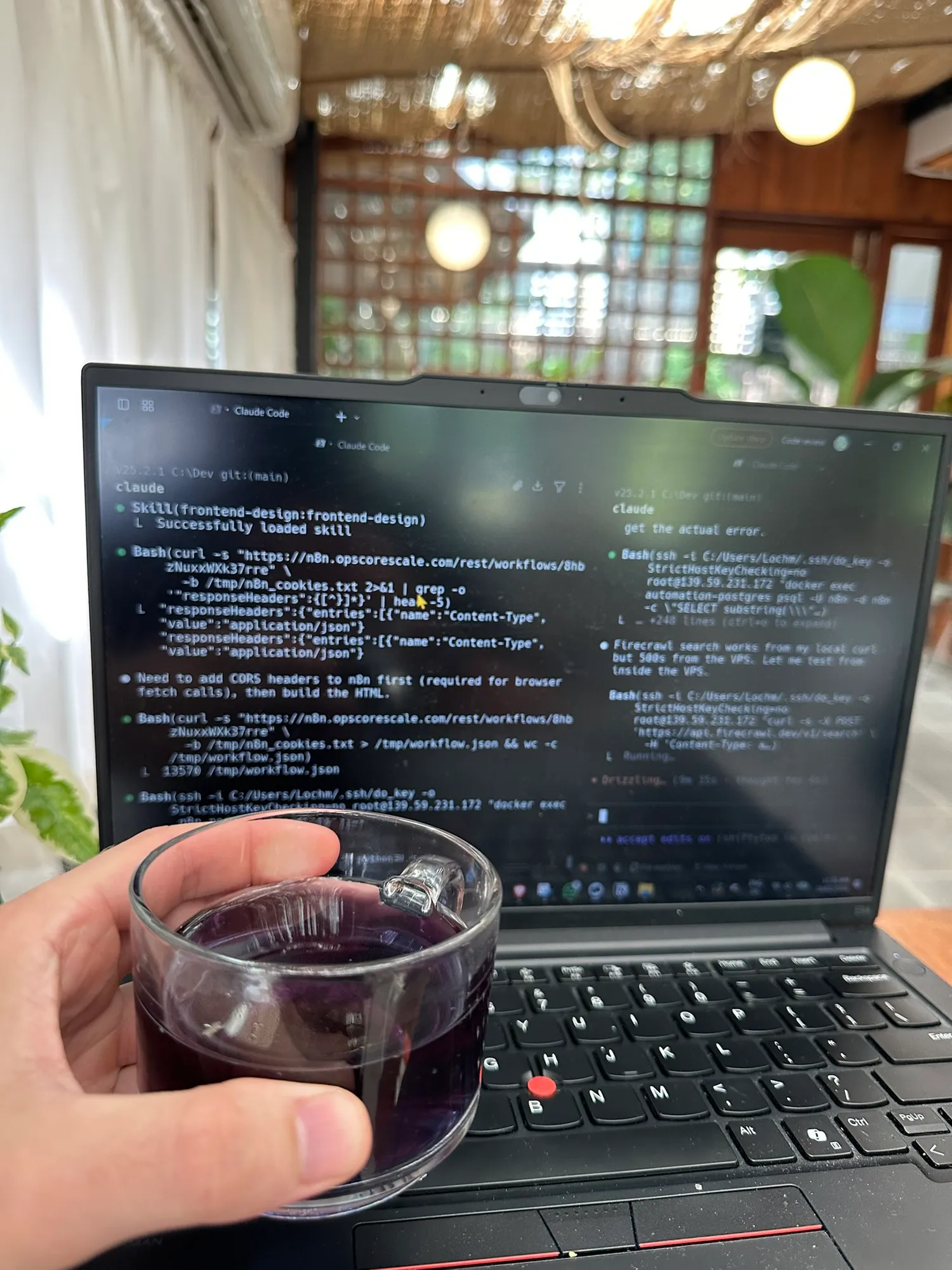
One Interface
Every work session starts in the same place — a terminal agent with a library of custom commands covering content, publishing, sales and daily operations.
- Surface
- Claude Code, terminal
- Commands
- A few hundred custom
- Repo
- One mono-repo — projects, vault, scripts
- Parallelism
- Sub-agents for independent work only
- Daily
- Morning brief · work · evening reflection
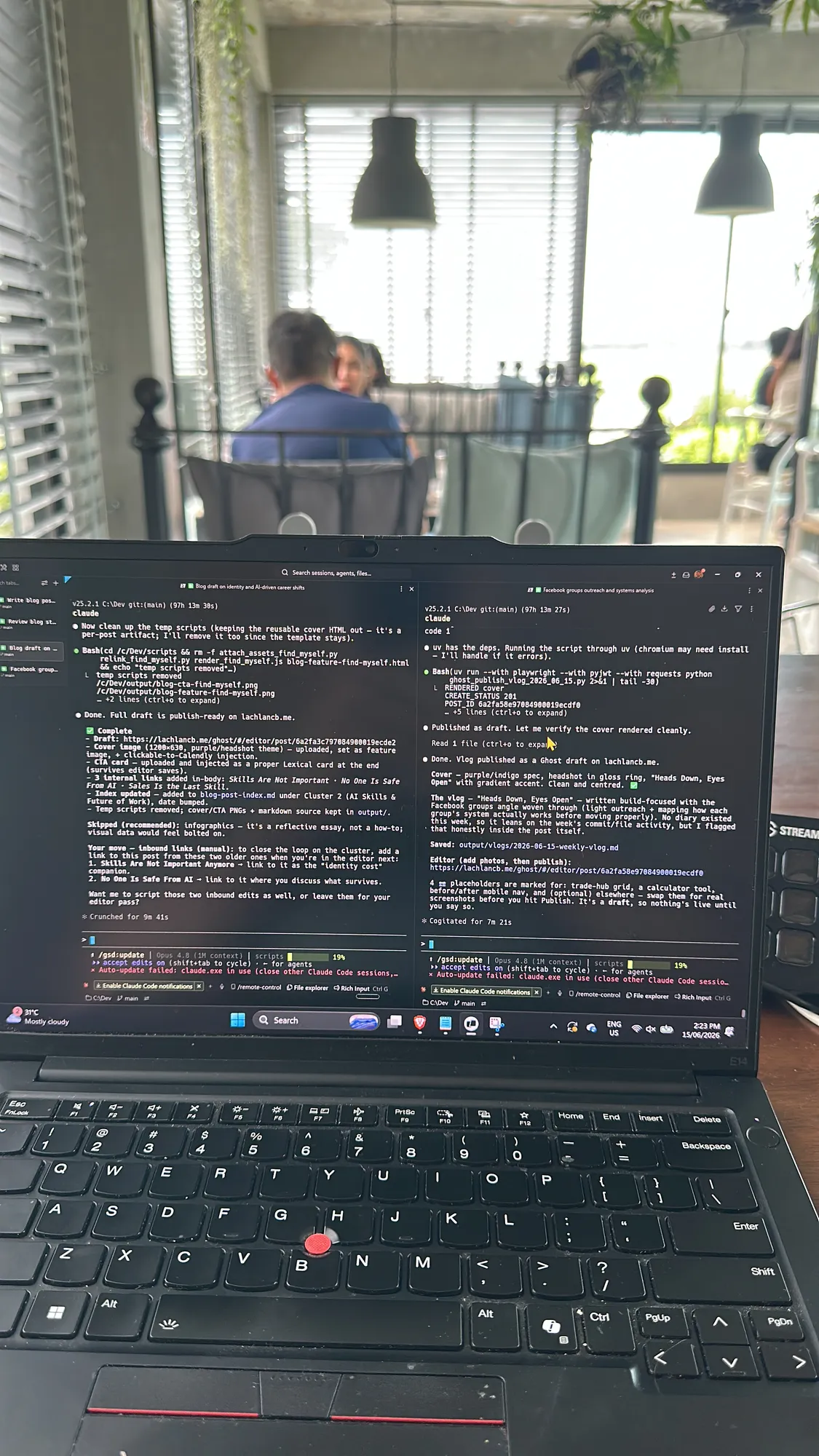
I run Claude Code against a single mono-repo. It holds every active project, the automation scripts, the knowledge vault, and the generated output. Coding, research, writing, deploying and debugging all happen through that one surface. There is no context-switching tax between "the writing tool" and "the deploy tool". There is only one tool.
The custom command library has grown to a few hundred entries. Some are complete pipelines. One command researches a topic, writes the piece, generates a cover image, and publishes or commits the file in a single call. Others are conversational rather than mechanical. The evening reflection command runs a coaching session against four behavioural patterns I've mapped. It calls them out when it sees them. That is not automation in the usual sense. It's a second opinion that already knows the history.
Context management is its own discipline. Analysis runs in a sandbox so raw file bytes never enter the conversation window. Reference material that gets read repeatedly is cached rather than re-sent. Work with three or more genuinely independent parts gets split across parallel sub-agents with clear file boundaries. Anything with a dependency chain stays sequential. Wrong parallelism is slower than no parallelism.
The failure mode is drift. A command breaks quietly when the service underneath it changes an API, and nothing surfaces the breakage until I try to use it. The mitigation is a periodic audit rather than an expectation of getting it right first time. Every gotcha I hit twice gets written into the project instructions file so the next session inherits the fix instead of rediscovering the bug.
The interface is only as good as what sits behind it — undocumented edge cases compound into invisible friction.
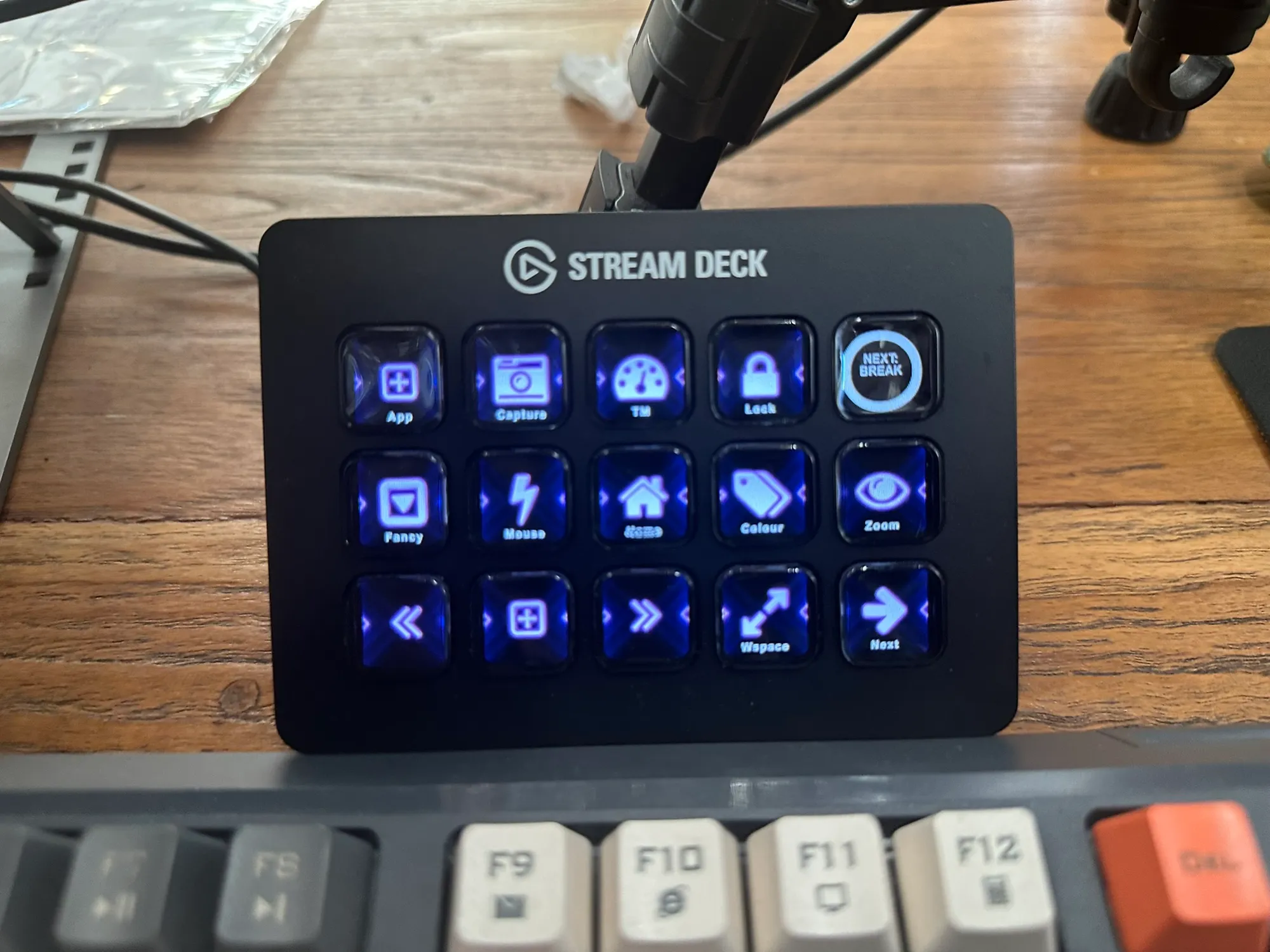
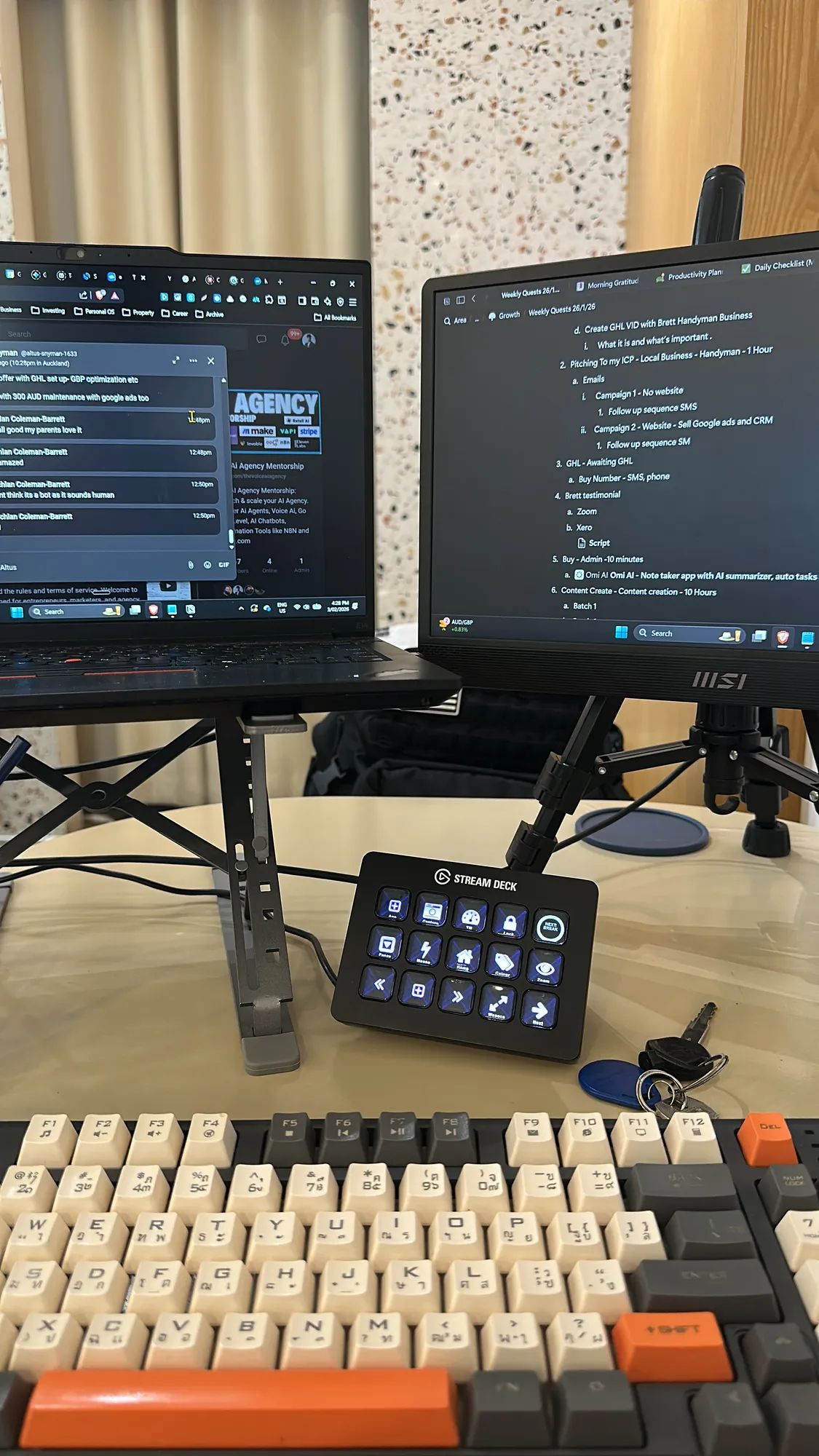
The Automation Backbone
A small cloud server running about sixteen containerised services, plus a set of cloud-scheduled routines. The always-on layer that works while I'm away from the machine.
- Server
- Single-core cloud VPS, 2 GB, Singapore
- Services
- ~16, Docker Compose
- Cloud routines
- ~20, report-only
- Server cron
- Anything needing the machine
- Mobile
- Messaging bot → non-root service account
- Rule
- Report-only → cloud. Machine-bound → cron.
The server is a modest single-core box in Singapore. Docker Compose manages the stack: workflow engine, agent API, vector store, Postgres, Redis, tracing, static file serving, backups, and health monitoring. It is headless and managed over SSH. Nothing about it is impressive. That's the point. It has survived two years because it is small enough to understand end to end.
The scheduling split is the design decision that matters most. Anything needing the machine itself (Docker, local files, the messaging bridge) runs as a cron job on the server. Anything that only calls external APIs and reports a result runs as a cloud-scheduled routine. That keeps it off the machine. It doesn't compete for memory or die when the box is under pressure. Roughly twenty routines and twice as many cron jobs, split on that single rule.
Everything that runs unattended reports into one channel. A daily intelligence digest, a weekly product scout, an algorithm-update watcher that stays silent unless something actually moved. That last one is the design I'm most attached to. A monitor that produces no output on a quiet day is doing its job. Most people build the opposite.
Mobile control runs through a messaging bot. It executes commands on the server under a dedicated non-root account, as a service unit so it survives reboots. Things break at inconvenient times. Being able to diagnose and restart from a phone, on a motorbike, in another country is worth a lot. More than the elegance of the code that does it.
The recurring constraint is memory. Two gigabytes across sixteen services means heavy operations queue behind each other. An hourly health monitor reports pressure. Anything inference-heavy goes to the cloud rather than the box. The limit is a forcing function. Anything that can't justify its footprint eventually gets dropped, which is a healthier default than infinite capacity.
Separate report-only work from machine-bound work. Mixing them is how you get 3 a.m. dependency failures.
The Knowledge System
A plain-markdown vault holds the operational reference. Notion holds the structured records. The split is deliberate and rarely crossed.
- Vault
- Markdown, inside the repo, git-tracked
- Templates
- ~42 operational reference files
- Structured
- Notion — content, CRM, intelligence
- Capture
- Messaging bot → dated markdown
- Backup
- Nightly git sync + weekly export
- Index
- Hard line cap — detail lives elsewhere
The vault is a folder of markdown files inside the same mono-repo as the code: operational reference, project notes, CRM entries, diary, research. Keeping it inside the repo means it is version-controlled and backed up by the same nightly sync as everything else. No separate service, no proprietary format, no dependency on a company continuing to exist.
The operational layer is the highest-leverage part. Reference files get read at the start of the sessions that need them. The rule is simple: anything looked up twice becomes a note. Anything debugged becomes a gotcha entry. The index file has a hard line cap, with detail delegated to separate files. Loading it stays cheap. A knowledge base that's expensive to consult doesn't get consulted.
Notion covers what markdown is bad at: filtered views, structured records, anything relational. Content planning, book synthesis, contact tracking. The split is simple. Operational reference goes where the interface can read it directly. Structured records go where they can be queried. I have twice tried to collapse the two into one system. Both times the result was worse than the split.
Capture runs through the messaging bot. A voice or text note becomes a dated markdown file in the vault without opening a laptop. That's the only reason the diary has survived. Anything requiring a laptop gets written for three weeks and then abandoned.
The honest weakness is currency. The vault is only as good as the last time I updated it. Synthesis (turning captured notes into something usable) is still manual. A weekly nudge exists precisely because without an external prompt the review drifts. That's not a tooling problem. I've stopped trying to solve it with tooling.
Operational reference belongs where your primary interface can read it directly — not behind an API call with a rate limit.
Interface
- Claude Code
- Custom command library
- Sandboxed analysis
- Parallel sub-agents
Automation
- n8n
- Docker Compose
- Cloud-scheduled routines
- Messaging bridge
- Slack as the output channel
Publishing
- Next.js on Vercel
- Ghost
- Supabase
- GitHub
Data
- Qdrant
- Postgres
- Redis
- Langfuse
- Markdown vault
- Notion
- Your Next Management System Isn't an App — It's Claude CodeFor years the answer to managing your life and business was an app — Notion, Linear, a stack of tabs. That era is ending. Here's why Claude Code is becoming the layer that runs everything.
- My AI Learns From Its Own Mistakes. Here's the Architecture.Five layers of self-learning infrastructure that make Claude Code remember failures, preserve context, and get smarter every session.
- 1,000 Hours in Claude Code: What Finally Made It ClickAfter 1,000 hours in Claude Code, here's what flipped it from frustrating to indispensable: skills, hooks, MCP, and feeding it your ecosystem.
- Claude Code + Obsidian: The Closest Thing to a Limitless PillHow I turned Obsidian into Claude Code's long-term memory — a limitless-style second brain my AI agents pull from in milliseconds, instead of re-researching every task.
- Skills Are Not Important Anymore. Here’s What Is.Skills used to define your career. Now they’re downloadable. Here’s how to find yourself again when everything you learned can be automated.
Deliberately non-specific in places — hostnames, keys and client-facing configuration stay out of public writing. The shape is accurate. The addresses aren't here.