·5 min read
Chiang Mai Runs on Arbitrage. Here's Why I Stayed
After 3 years living here, here's why Chiang Mai became Asia's quiet nomad capital - the arbitrage, the weekly community, the weather, and the one honest catch.

Chiang Mai is a mountain city in northern Thailand that has quietly become the most established remote-work hub in Asia. I've lived here for three years. People still ask me why — like it's a stopover, not a base.
It isn't a stopover. It's a system. Cheap to run, rich to live in, and built — almost by accident — for people who work online.
Here's what actually keeps people here.
The Arbitrage Nobody Says Out Loud
The honest answer is geographic arbitrage: you earn at one country's rate and spend at another's. I've broken down how the mechanics actually work, and who it does and doesn't suit separately — this piece is about why Chiang Mai specifically.
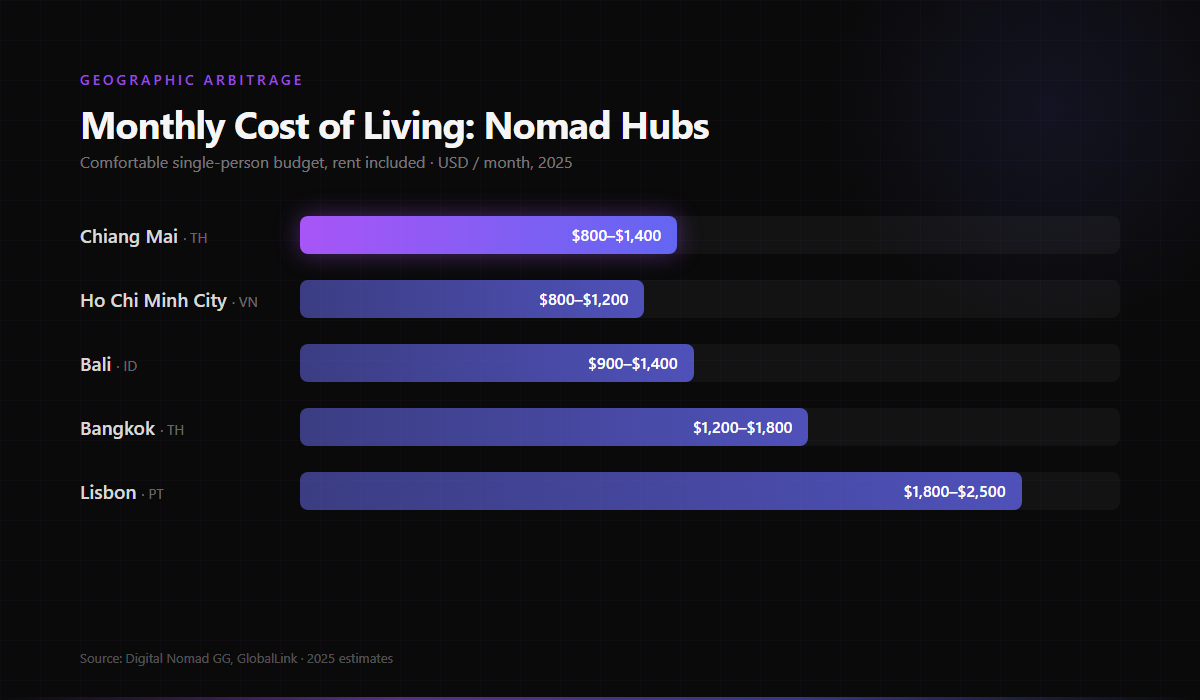
You can live comfortably in Chiang Mai on $800–$1,400 a month, rent included. That's a modern one-bedroom with a pool, fast fibre, street food daily, and a scooter. The same lifestyle in Sydney or London costs five times more.
The trap people fall into is thinking "cheaper" means "lesser." It doesn't. The apartment is new. The internet hits 60–120 Mbps. The hospitals are world-class and English-speaking. Chiang Mai is roughly 30–40% cheaper than Bangkok for the same quality of life.
So the move isn't "downgrade my life to save money." It's: keep the quality, cut the cost, and free up the difference — for travel, for building, for time. That's the whole game.
Related: Your Circle Is Your Ceiling — why your environment quietly decides who you become
The Community Runs Itself
The second reason is the part you can't fake: there are already people here.
Chiang Mai consistently ranks as NomadList's #1 city in Asia and a global top 5. Over 30,000 expats live here. The main "Digital Nomads Chiang Mai" Facebook group has 20,000+ active members. There are coworking events, founder meetups, and skill nights running every week — you don't organise the scene, you just show up to it.
That matters more than it sounds. Most "cheap places to live" are lonely. The arbitrage works, but you're isolated. Chiang Mai solved the social problem first. You land, post in a group, and have coffee with three other operators by Friday.
A cheap city with no community is just exile with good wifi. Chiang Mai has both.
Weather, Culture, and the One Honest Catch
Now the part most posts skip, because I want you to actually trust this.
The culture is the draw underneath the spreadsheet. Over 300 temples. Lanna heritage, slow mornings, mountains 20 minutes from the old city. It's calm in a way that's hard to describe until you've felt your shoulders drop.
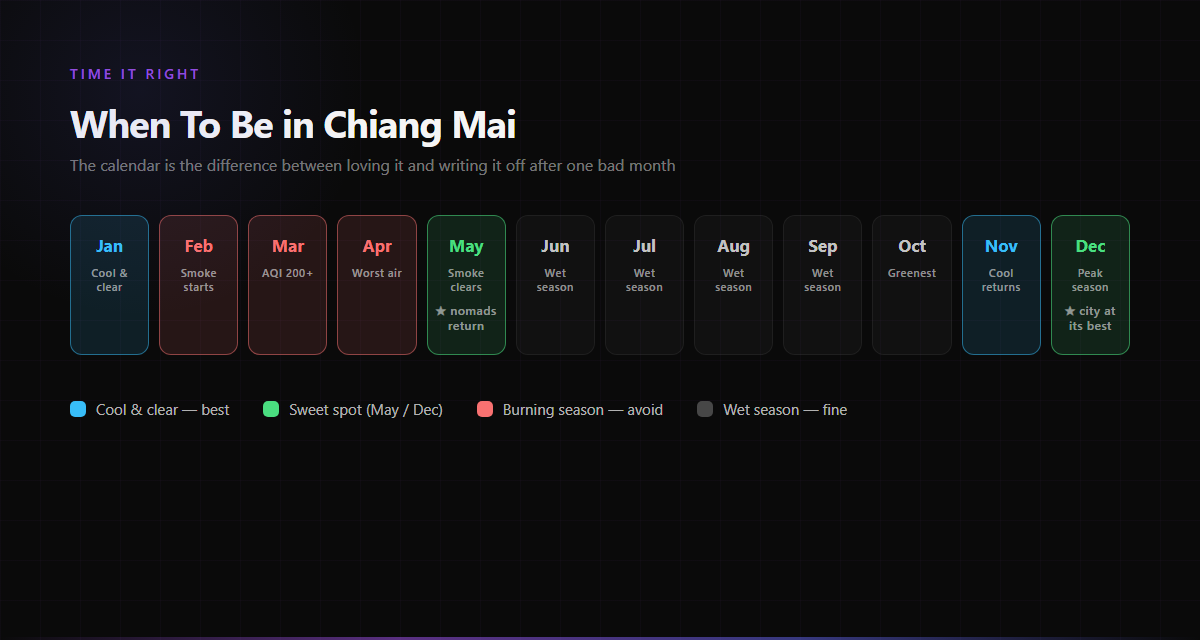
But there's a catch: burning season. From roughly February to April, agricultural smoke pushes air quality into the unhealthy range — AQI regularly above 200. Plenty of people leave for those months. I won't pretend it isn't real.
So if you're testing the city, time it. My two favourite windows are May and December:
- December — the start of cool season. Clear skies, 20°C mornings, the city at its best.
- May — the smoke has cleared, the wet season is starting, and the nomad crowd flows back in. The energy lifts.
Knowing the calendar is the difference between loving Chiang Mai and writing it off after one bad month.
Why the Hub Keeps Growing
Hubs compound. Each wave of remote workers makes the next wave easier — more coworking, more cafés built for laptops, more events, more reasons to stay.
Chiang Mai has held NomadList's top spot for years, and that's not luck. It's a flywheel: cheap base + real community + infrastructure → more people → better infrastructure → more people. The city has become the benchmark every other nomad destination gets measured against.
For anyone building a location-independent life, that flywheel is the actual asset. You're not just renting a cheap apartment — you're plugging into a system that's been refined by a decade of people doing exactly what you're trying to do. (It's a big part of why I started documenting my life here in the first place.)
Three years in, I'm still here. That's the most honest review I can give.
FAQ
What is the best time of year to visit Chiang Mai?
December and May. December starts the cool, clear season; May is when the burning-season smoke has cleared and the nomad community returns. Avoid February to April if you're sensitive to air quality.
How much does it cost to live in Chiang Mai?
A comfortable single-person budget runs $800–$1,400 per month including rent, food, transport, and coworking. Budget nomads manage closer to $700–$900; a luxury lifestyle still lands under $3,000.
Is Chiang Mai good for digital nomads?
Yes — it's ranked NomadList's #1 city in Asia, with 30,000+ expats, fast fibre internet, dozens of coworking spaces, and weekly meetups. The community and infrastructure are the most developed in Southeast Asia.
What is the biggest downside of living in Chiang Mai?
Burning season. From February to April, agricultural smoke pushes air quality to unhealthy levels (AQI 200+). Many residents travel during these months. There are also no beaches nearby — the coast is a short flight away.