·7 min read
Geographic Arbitrage Is the Best Raise You Never Got
Geographic arbitrage means earning in a strong currency while spending in a weaker one. Here's what it is, how to actually set it up, and who it works for.

Most people optimise their income. Fewer optimise their costs. Almost nobody does both at once.
Geographic arbitrage is the move where you do both.
TL;DR: Geographic arbitrage means earning in a country with a strong currency while living in one with a weaker one. The gap between those two numbers is your edge — and the edge buys runway, not luxury. It works best if you have a portable skill or existing remote clients. It doesn't work if your income is tied to a physical location.
What Geographic Arbitrage Actually Is
Geographic arbitrage is an income strategy that uses currency asymmetry as leverage. You earn at one country's rate and spend at another's — and you keep the difference.
That's the whole concept. The execution is what most people get wrong.
This isn't about living cheaply. Most people who try geographic arbitrage for the wrong reasons burn out within a year. They're chasing a low price, not a high ratio. The point isn't to suffer less. The point is to buy runway — months of operating capital that lets you take risks, say no to bad clients, and build something without panic.
Here's what the math actually looks like.
Say a consultant billing AUD $8,000 a month in Australia. They take home roughly $5,500 after tax. Sydney rent is $3,000. After rent, food, transport, and life, they might clear $1,000–$1,500 a month. Full capacity, no room to breathe.
Move the same consultant to Chiang Mai, where a comfortable month — rent, food, coworking, gym — runs around AUD $1,200. Now they clear $4,300. Roughly three times the runway. The income didn't change. The geography did.
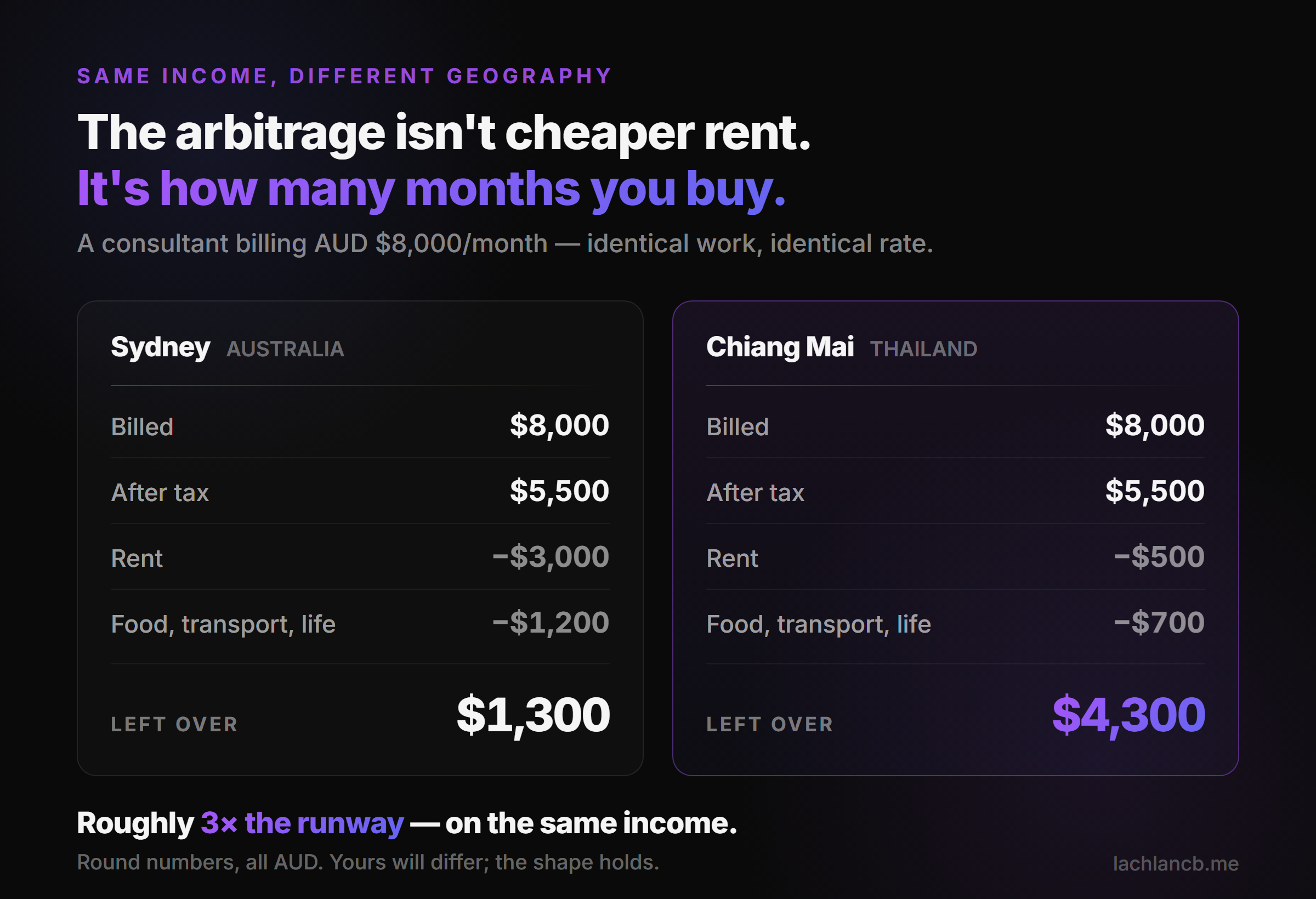
Round numbers, and yours will differ. But the shape holds, and it's simple arithmetic most people never actually run.
Related: Chiang Mai Runs on Arbitrage. Here's Why I Stayed
How to Actually Set It Up
The concept is simple. The setup has a few moving parts worth knowing before you book a flight.
Build a remote income first
This is the step most people skip. Geographic arbitrage only works if your income travels with you. A salary tied to a Melbourne office doesn't count. Freelance clients who pay you in AUD or USD and don't care where you sit — that counts.
The barrier here has dropped hard — a solo operator with the right tooling can now deliver what used to need a small team, which is why running an entire operation from a single laptop is no longer theoretical. A consultant billing at professional rates, a writer with retainer clients, a developer running async sprints — all of them can run this play. If you can build something, write something, manage something, or sell something, you can probably do it from anywhere.
Pick a base with the right ratio
The spread matters more than the absolute cost. Vietnam is cheaper than Chiang Mai. Vietnam also carries more admin friction — harder banking, lower English fluency in professional contexts, more regulatory uncertainty. The right move isn't the cheapest city. It's the city with the best income-to-expense ratio combined with the lowest operational friction.
Chiang Mai is the benchmark for a reason. The cost structure, the expat community, and the functional English compound into a place you can actually build from — not just survive in. I've been based in Thailand three years now. The city consistently outperforms the brochure version of itself.
Sort the three pieces of admin nobody mentions
Visa. Thailand's tourist visa allows 60 days, extendable by 30. A longer stay usually means a border run or a proper visa arrangement. Research this before you arrive, not after — the rules change, and making a major decision based on six-month-old forum posts is how people get caught out.
Banking. Open a multi-currency account before you leave. Wise and Revolut both work well for moving money across borders without exchange fees eating the margin. Your home bank card will charge 2–4% on every foreign transaction. That adds up across a year.
Tax. You remain an Australian tax resident until you formally break residency — which is a deliberate act, not an automatic consequence of being abroad. Get advice from an accountant who handles cross-border clients. Not a Reddit thread.
Give it 90 days before you decide anything
The first month is always adjustment. The second month is where you start to see whether the city works for you. The third month is when the rhythm either sets or it doesn't. Most people make the call too early — on a bad week in month one, or a great week when everything still feels like holiday.
Who It Actually Works For
I'll be honest, because the version of this essay that flatters everyone is useless.
Geographic arbitrage works if:
- Your income is already portable, or you have a clear path to making it so
- You're comfortable with some administrative uncertainty — visas, tax position, renewal timelines
- You're building something, not avoiding something. The people who last here are solving a work problem, not fleeing a life problem
- Your income sits above roughly AUD $40,000–$50,000 a year. Below that, the gap after AU taxes isn't wide enough to make the move meaningful
It doesn't work if:
- Your income depends on physical presence — construction, hospitality, local services
- You have heavy anchor obligations that keep you geographically fixed. That's a legitimate constraint, not a failure
- You're making a permanent decision based on a two-week holiday. The holiday version of a city and the base version are completely different products
The people I know who have made this work long-term all have one thing in common: they treated it as a deliberate financial and operational decision, not a vibe. The vibe people tend to leave by month four.
The Benefit Nobody Puts in the Job Description
Here's the part that surprised me after three years of running this.
The money matters. But the real asset is what the money buys: the ability to make different decisions.
When your burn rate drops 60%, you stop taking bad clients to cover rent. You say no to projects that drain you. You take the month to build the thing you've been putting off. You don't make panic decisions when a client churns.
None of that is possible when you're running on thin margins in an expensive city. The arbitrage doesn't just cut your costs. It changes the quality of every business decision you make from inside it.
That's the raise nobody puts in the job description.
FAQ
What is geographic arbitrage? Geographic arbitrage is earning income in a country with a strong currency (AUD, USD, GBP) while living in a country with a weaker currency and lower costs. The gap between what you earn and what you spend is the edge.
Do I need to be a digital nomad to use geographic arbitrage? No — but you need a remote income. Freelancers, consultants, agency owners, and remote employees all qualify. The key is that your income doesn't require physical presence in a specific location.
What's the best city for geographic arbitrage in Southeast Asia? Chiang Mai is the most established option — strong infrastructure, an active expat community, low costs, and functional English. Bali, Lisbon, and Tbilisi are popular alternatives. The right city depends on your income level, visa requirements, and how much administrative friction you're willing to handle.
Ready to build a business you can run from anywhere? Book a 30-min AI discovery call and I'll show you exactly how the stack works.