·5 min read
Building Isn't the Moat Anymore. Distribution Is.
Building a product is cheap now. Distribution is the real moat. Here's what I learned shipping The 20% Vault - and the two ways to actually get traffic.
TL;DR: Distribution is the system that gets your product in front of the right people — and in 2026 it's the only moat left. AI made building cheap, so the build is no longer the hard part. The hard part is trust and attention. There are two ways to earn them: a personal brand (slow, durable) or mass outreach and paid (fast, rented). Pick one and go deep.
Distribution is the system that gets your product in front of the right people — and right now, it's the only real moat left.
I learned this the hard way building The 20% Vault.
The product wasn't hard. It wasn't technical, draining, or slow. AI did most of the heavy lifting. What ate the months — what actually mattered — was figuring out how to get it in front of people who'd care. The build was a weekend. The distribution was the war.
If you're still optimizing the thing you're making, you're solving last year's problem.
Building Stopped Being the Hard Part
The cost of building collapsed. A single operator with Claude and a few tools can now ship what used to take a team a quarter. Feature velocity used to be a moat. Now everyone ships fast — so shipping fast stopped being a differentiator.
That's the part most people haven't internalized. They still think the edge is in the code.
It isn't. When anyone can build the thing in a weekend, the thing has no defensibility. I wrote about this when I replaced my agency team with AI decision-making — the leverage is real, but leverage everyone has is just a new baseline, not an advantage.
The build is now table stakes. The question is what you do after.
So What's Actually the Moat Now?
The moat moved from code to distribution and trust. Those are the only two things that still compound when the product itself is commoditized.
Look at where the money actually goes. PwC's 2026 AI study found 74% of AI's economic value is captured by just 20% of organizations — the ones who win aren't building better, they're reaching further. Same tools. Different distribution.
Trust is the multiplier. AI can clone your features overnight. It can't clone the relationship you've built with an audience, or the reputation that makes someone choose you on sight. That's also why sales is the last skill AI can't touch — it runs on trust, and trust doesn't scale on a GPU.
So if the build is free and trust is the moat, the whole game becomes: how do you earn attention and keep it? There are two roads.
Path 1 — Build a Personal Brand
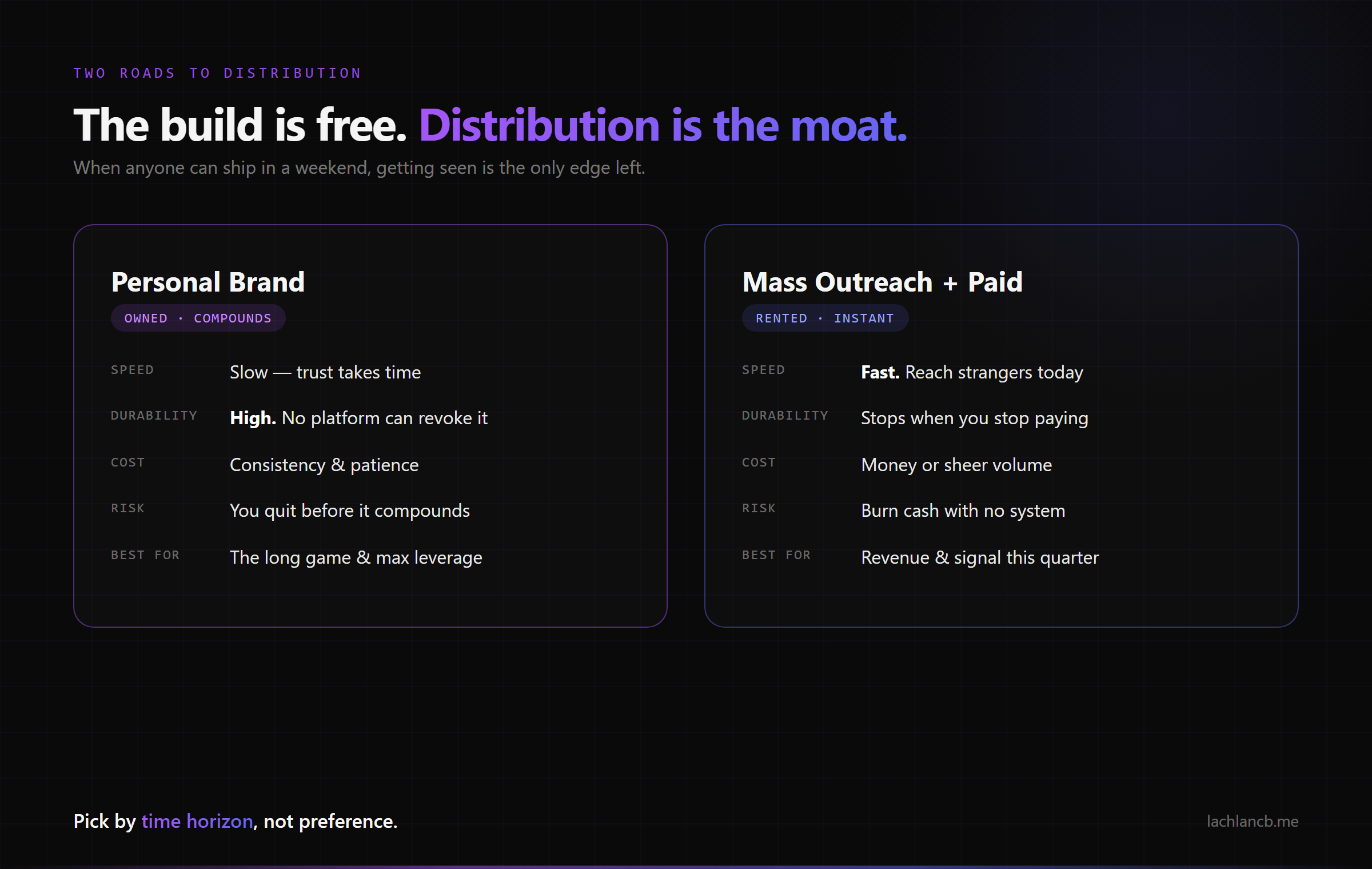
A personal brand is owned distribution that compounds over time. You show up, you teach, you ship in public, and slowly a group of people start trusting your judgment. Then anything you build lands on a warm audience instead of a cold one.
The upside: it's durable and it's yours. No platform can revoke it, no ad account can ban it. The reputation you build today still pays in three years.
The downside: it's slow. There's no shortcut to trust. You're planting a tree, not flipping a switch.
This is the leverage play if you're in it for the long game. It's the difference between renting attention and owning it.
Path 2 — Mass Outreach and Paid Promotion
Mass outreach is rented distribution you can turn on instantly. Cold email, paid ads, influencer placements, partnerships — you pay (in money or volume) to put your product in front of strangers today.
The upside: speed and scale. You don't wait years for an audience. You buy the reach now and learn what converts fast.
The downside: the moment you stop paying, the traffic stops. It's a faucet, not a well. And it only works at volume — which is exactly why volume beats strategy. One cold email is noise. Ten thousand is a channel.
This is the play when you need traffic now and you're willing to pay for the lesson.
Which One Should You Pick?
Pick based on your time horizon, not your preference. If you can afford to play long, build the brand — it's the higher-leverage asset and it makes everything else cheaper later. If you need signal and revenue this quarter, run outreach and paid, then reinvest the proceeds into the brand.
The mistake is doing neither and going back to polishing the product. The product is done. The product was always going to be done. The work that's left — the work that actually decides whether anyone sees it — is distribution.
Build less. Distribute more.
FAQ
What does "distribution is the moat" actually mean?
It means your competitive advantage now comes from your ability to reach and convert an audience, not from the product itself. When AI makes the product easy to copy, the defensible asset becomes the trust and attention you've built around it.
Why is building no longer a competitive advantage?
Because AI collapsed the cost of building. A solo operator can now ship in days what once took a team months, so speed and features are no longer rare. When everyone can build fast, building stops being a differentiator.
Should I focus on a personal brand or paid outreach first?
If you have time and patience, start the personal brand now — it compounds and you own it. If you need revenue this quarter, run paid and outreach for fast signal, then reinvest into the brand. Most operators eventually need both.
Can't AI just handle distribution too?
AI can scale the mechanics — writing, sending, posting — but it can't manufacture trust or reputation. Those are earned through consistency over time, which is exactly why distribution stays defensible even as building gets automated.
Related: Your Circle Is Your Ceiling — why your environment quietly decides who you become
Related: Anyone Can Build Now. That's Why Selling Just Became Everything
If distribution is the moat, selling is how you build it. I wrote about why that skill got scarce — and what I'm doing about it — in The AI Sales Gap: Why Builders Ship and Never Sell.