·6 min read
Speed to Lead Is the New Moat for Building SaaS in 2026
Building SaaS in 2026? Speed to lead now means speed to validated truth. Why fast human conversations beat months of building - and how to run them.
Speed to lead is a sales metric that measures the time between an enquiry arriving and a human responding to it. In 2026, it's also the sharpest rule I know for building SaaS — because AI collapsed the cost of building, and the only race left is the race to validated truth.
Here's the trap. Building is now so cheap that skipping validation feels logical. Why spend two weeks calling strangers when you could ship the thing in a weekend? So founders ship. Releases explode. Retention stays flat.
The founders winning right now aren't the fastest builders. They're the fastest learners. They treat every idea like a hot lead: respond immediately, qualify it with real humans, kill it fast if it doesn't qualify.
TL;DR: Speed to lead used to mean answering enquiries fast. For anyone building SaaS in 2026, it means getting to validated truth fast — real conversations with real people before you build anything. Information decays. Move on it in minutes, not months.
The Sales Stat Every Builder Should Steal
Call a lead within 5 minutes instead of 30 and you're 100x more likely to make contact — and 21x more likely to qualify them. That's the MIT/InsideSales Lead Response study (100,000+ call attempts).
Harvard Business Review ran a separate audit of 2,241 companies. The average response time to a new lead: 42 hours. 23% never responded at all. Firms that responded within an hour were 7x more likely to qualify the lead than those an hour slower — and 60x more likely than those who waited a day.
The lesson under the stat: information decays. A lead's interest is a perishable asset. Every hour you sit on it, the signal rots.
Your idea works exactly the same way. The moment you have one, you're holding a hot lead on the truth. Sit on it for six months of quiet building, and you've done the equivalent of returning a customer's call two days late — the market has moved, and you learned nothing while it did.
Building Got Cheap. Knowing Didn't.
The #1 reason startups die hasn't changed: 42% fail because they built something nobody wants (CB Insights). Not bad tech. Not weak marketing. No market need.
What has changed is the build side. AI coding tools made shipping roughly 10x faster — and one analysis of the aftermath found exactly what you'd expect: releases exploded, downloads stayed flat, retention didn't budge. When building is cheap, skipping discovery feels logical. It isn't. It just delays the moment you discover nobody wanted the thing — usually after 6–12 months and $50,000–150,000 of sunk effort.
I've written before that building isn't the moat anymore — distribution is. This is the same shift viewed from the other end: when everyone can build, the edge isn't in the building. It's in knowing what to build before your competitors finish guessing.
Speed to Truth: Do Whatever Gets a Real Answer Fastest
The fastest route to validation is a real conversation with someone who has the problem. Not a report. Not a subreddit scroll. Not an AI deep-research run.
Online market research gives you the shape of a market. It can't give you the weight of the pain. A TAM slide won't tell you whether a pest control owner would actually pay to fix their enquiry handling — but fifteen minutes on the phone with one will. Market research validated by people's actual concerns outweighs anything you find published online.
So use whatever channel gets you a live human fastest:
- Pay someone for 30 minutes of their time. $50 is the cheapest product insurance you'll ever buy.
- Call them. Highest signal per minute of any channel.
- Email or DM where calls can't reach. Slower, still real.
The channel doesn't matter. The speed of validated signal does.
One warning: don't lead the witness. A founder surveyed 200 small business owners: "Would you use automated social media scheduling?" 85% said yes. He built it. Nobody paid. "Would you use this?" produces false positives every time. Ask what they do today, what they've tried, and what it costs them — behaviour and spend, never hypotheticals. It's why 67% of failed SaaS founders, in one survey, spent more time building features than talking to customers. Talking is the work. Stop learning, start building — and the first thing to build is a pipeline of conversations.
My Rule Before Any Full Build
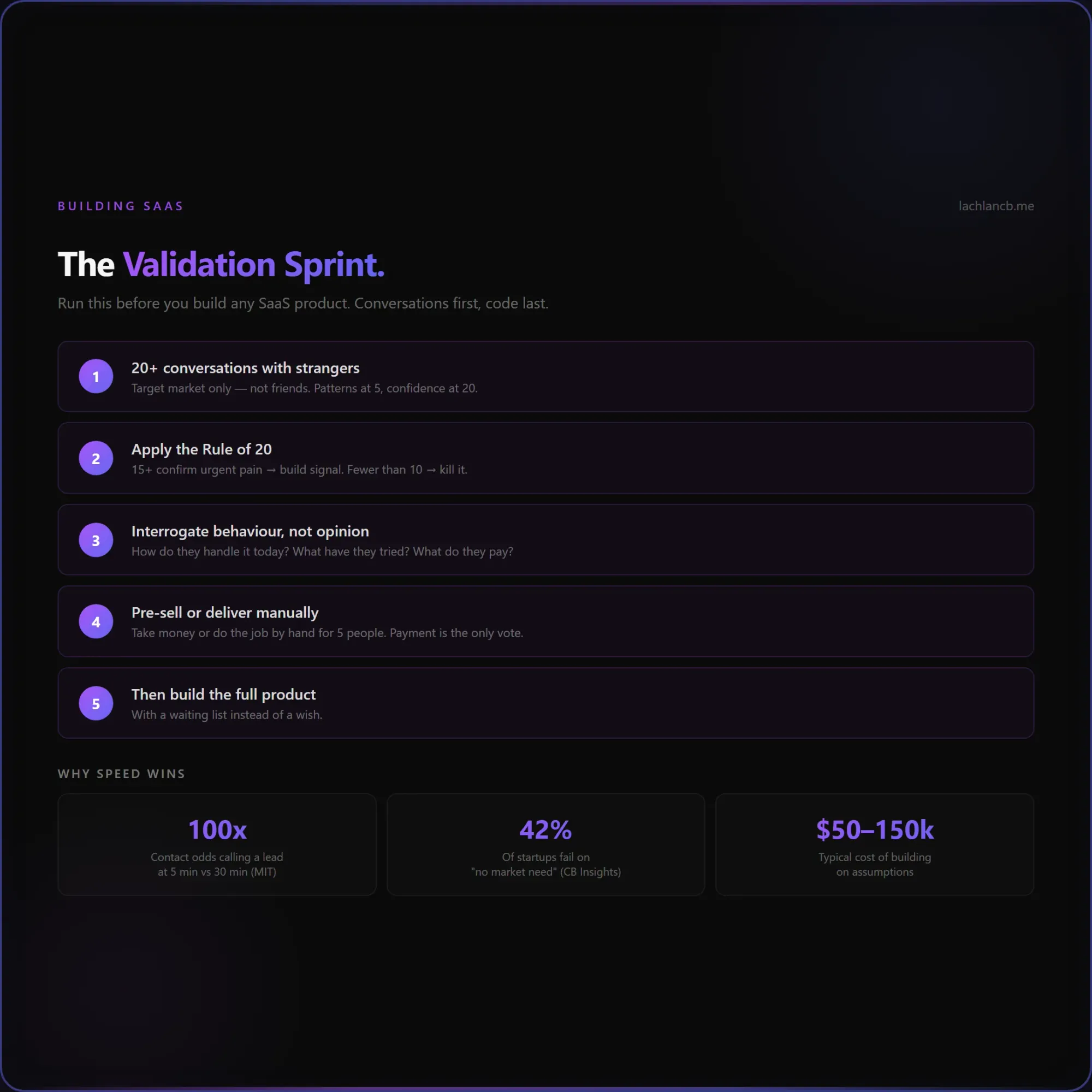
Before any full product, run a validation sprint:
- 20+ conversations with strangers in the target market — not friends. Patterns emerge by conversation 5; confidence arrives around 20.
- Apply the Rule of 20. 15+ confirm the problem is urgent and costing them money → strong build signal. Fewer than 10 → kill it and move on.
- Interrogate behaviour, not opinion. How do they handle it today? What have they tried? What do they pay?
- Pre-sell or deliver manually. Take money, or do the job by hand for 5 people, before writing real code. Payment is the only vote that counts.
- Then build the full product — with a waiting list instead of a wish.
This is a volume game, not a cleverness game. The founder who has 30 conversations this month beats the one perfecting a landing page — the Rule of 100 applies to validation as much as anything else.
FAQ
What does speed to lead mean when building SaaS?
It's the adaptation of the sales metric to product decisions: the time between having an idea and getting real-world evidence about it. Fast movers validate with live conversations in days; slow movers build for months on assumptions and find out too late.
How many customer conversations do I need before building a SaaS product?
20–30 with strangers who match your target customer. Patterns show up after 5 conversations, but you need 20+ for confidence. If 15 or more confirm the problem is urgent, build. Under 10, kill it.
Is online market research enough to validate a SaaS idea?
No. Online research shows market size and competitors, but it can't confirm urgency or willingness to pay. Validation needs direct evidence — interviews, pre-sales, or manual delivery — from people who actually have the problem.
What's the fastest way to validate a SaaS idea in 2026?
Get paid before you build. Pre-sell to your interview pipeline or deliver the outcome manually to 5–10 people. If nobody pays at concierge scale, no amount of software fixes that.
Move at the Speed of Truth
The build race is over — AI ended it. The race that's left is to validated truth, and it's won in conversations, not codebases. Treat every idea like a lead that goes cold in 5 minutes. Call someone today.
If you're building SaaS this year, steal the sprint above before you write a line of code. And if you want more systems like this, subscribe — I publish what I learn from running these plays in my own business.