·6 min read
Why Sales Is the Last Skill AI Can’t Touch
AI commoditised content, design, and support. But one-to-one sales? That supply hasn’t changed. Here’s why it’s the most durable leverage you can build.
Everyone’s Talking About the Wrong Thing
The future of sales is the hottest topic in every LinkedIn feed right now. AI tools. Automated outreach. Chatbots that qualify leads while you sleep.
And most of it misses the point entirely.
I’ve been making cold calls for my agency. Real ones. Dialling handymen, plumbers, local business owners. And what I keep hearing surprises me — not because it’s new, but because it’s so obvious everyone forgot it.
People don’t trust AI. They trust people.
The business owners I talk to have a gut reaction to anything that sounds automated. They’ve been burned by robocalls. They’ve ignored chatbot pop-ups. They associate “AI” with something trying to extract money from them — not help them.
That reaction isn’t going away anytime soon.
AI Is Infrastructure. Sales Is Connection.
Here’s the distinction nobody makes cleanly enough.
AI is incredible at infrastructure. It can write emails, sort leads, transcribe calls, build reports, and route workflows. I use it every day. It’s the backbone of how I run a lean operation from Thailand.
But infrastructure doesn’t close deals.
Closing happens in the moment someone decides they trust you enough to say yes. That moment is emotional. It’s built on tone, timing, and the feeling that the person on the other end actually gives a damn.
AI can’t fake that. Not yet. Maybe not ever.
Sales isn’t persuasion or pressure. It’s a structured way of helping humans move from an old reality to a new one. That requires empathy. It requires reading the room. No model does that reliably.
Cold Calling Is Having a Comeback
This is the part that surprises people.
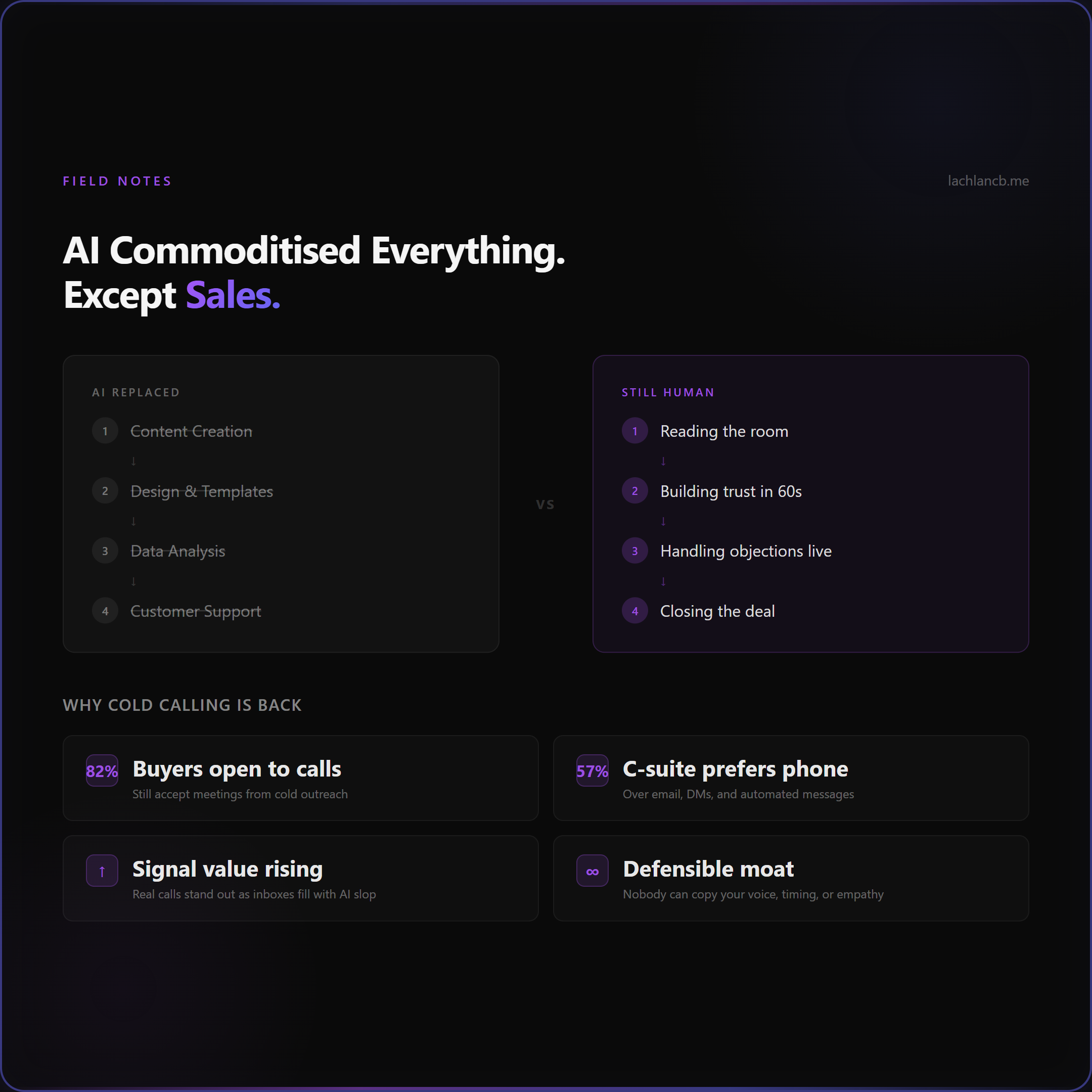
In a world drowning in automated DMs and AI-generated emails, a real phone call stands out. Recent data shows 82% of buyers are still open to meetings from cold calls, and 57% of C-level executives actually prefer the phone over other outreach channels.
Think about that. The most senior decision-makers — the ones who’ve seen every pitch — still pick up the phone.
Why? Because a phone call is a signal. It says: I’m a real person, I did the work to find your number, and I have something worth 30 seconds of your time.
That signal gets stronger as AI floods every other channel. When everyone’s inbox is full of generated slop, the person who picks up the phone wins.
The Trust Gap AI Can’t Close
There’s something deeper going on here that goes beyond preference.
When you buy something from a person, you’re not just buying the product. You’re buying their conviction. Their energy. The way they pause when you push back, think for a second, and come back with something real instead of a scripted rebuttal.
That’s soul. And soul is what separates a transaction from a relationship.
I’ve talked to tradies who’ve been pitched by every software company under the sun. Automated emails. LinkedIn bots. Facebook ad funnels. They’ve seen it all. And the universal response is the same — they ignore it.
But when a real person calls and says “Hey, I noticed you don’t have a website — how are people finding you right now?” — that lands different. Because it’s specific. It’s curious. And it came from a human being who took 10 seconds to look them up.
AI can generate a thousand personalised emails. But personalisation isn’t the same as personal. One is a template with a name swapped in. The other is a human choosing to pay attention.
That gap is where deals happen. And I don’t see it closing.
The Leverage Angle Nobody Talks About
Most people think about sales as a grind. Dial, pitch, get rejected, repeat.
But if you zoom out, sales is one of the highest-leverage skills you can own — specifically because AI can’t easily replicate it.
Think about what AI has already commoditised:
- Content creation — anyone can generate articles, posts, ads
- Design — templates and generators everywhere
- Data analysis — dashboards build themselves now
- Customer support — chatbots handle 80% of tickets
These skills are losing their premium. Supply is exploding.
But one-to-one sales? The ability to read a stranger, build trust in 60 seconds, handle objections on the fly, and close? That supply hasn’t changed. If anything, fewer people are developing it because they assume AI will handle it.
That’s where the leverage is. The scarcer the skill, the more valuable it becomes. Human insight in sales consistently outperforms AI on the metrics that actually matter — conversion, deal size, and retention.
Positioning Still Wins
None of this means you should ignore AI. That would be stupid.
The play is to use AI for everything it’s good at — research, prep, follow-up, CRM hygiene, content — and then show up as a human where it counts.
The future of sales isn’t AI or human. It’s AI doing the boring stuff so humans can do the important stuff. AI won’t replace sellers, but it will make the good ones unstoppable.
How you position yourself in that dynamic matters more than which tools you use. Are you the person who hides behind automations? Or the person who picks up the phone?
Why Most People Will Get This Wrong
Here’s what I think happens over the next few years.
AI tools get cheaper. Everyone gets access to the same outreach bots, the same email generators, the same lead scrapers. The barrier to “doing sales” drops to zero.
And that’s exactly why most people will fail at it.
When everyone has the same automated playbook, nobody stands out. The inbox gets noisier. The LinkedIn DMs get more robotic. The ads blend together into one big blur of “let me help you scale.”
The people who win will be the ones who do the thing nobody else wants to do anymore — pick up the phone, have an awkward first 10 seconds, and earn attention the hard way.
It’s not efficient. It’s not scalable in the way tech people want it to be. But it’s defensible. Nobody can copy your voice, your timing, or the way you make someone feel heard.
That’s the moat. Not your tech stack. Not your automations. You.
The Bet I’m Making
I’m doubling down on direct, human outreach. Cold calls. Real conversations. Building relationships one handyman at a time.
Not because it’s romantic. Because the math works.
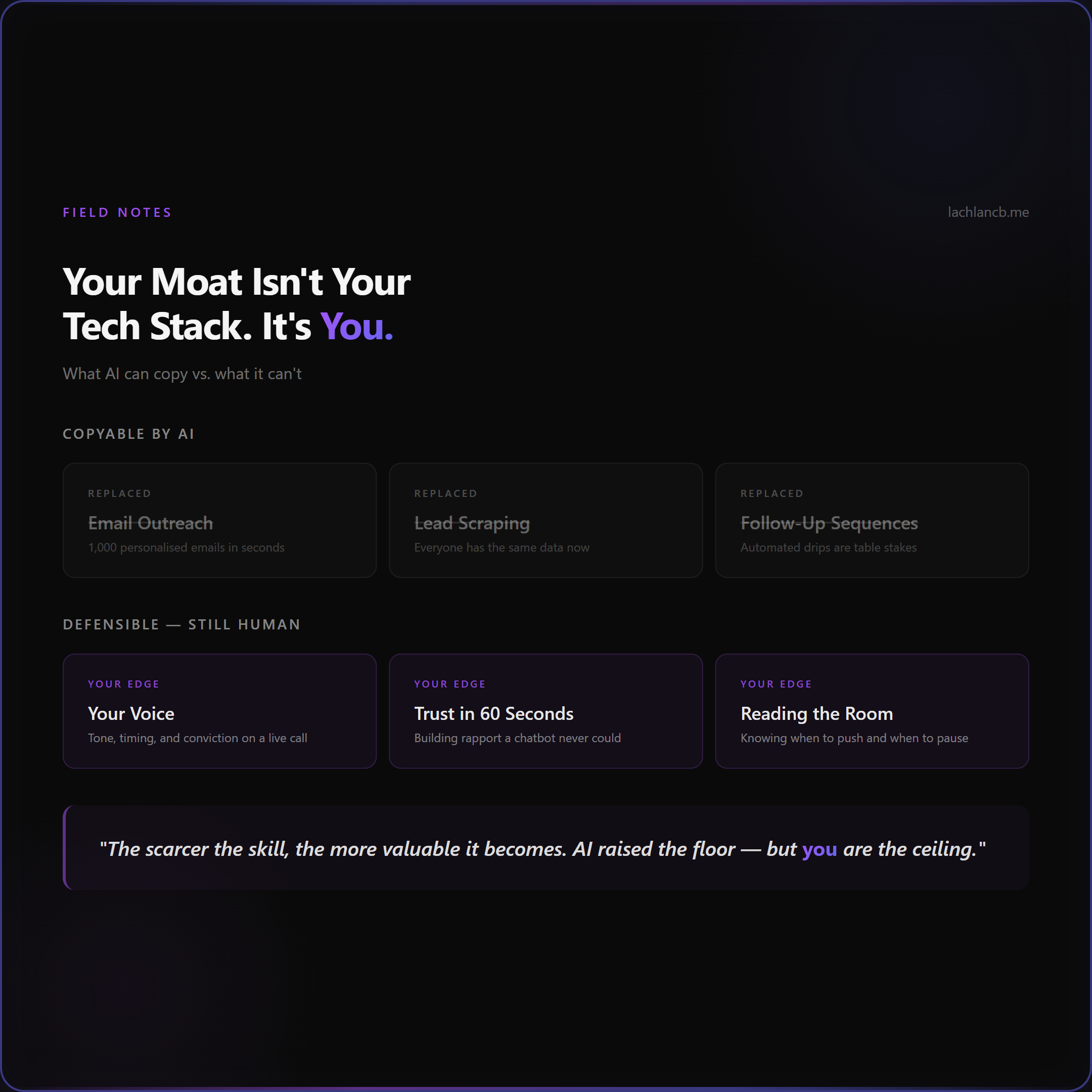
AI raises the floor for everyone. It makes average marketers adequate and adequate marketers good. But it doesn’t touch the ceiling. The ceiling is still reserved for people who can sell — who can sit across from someone (or on the other end of a phone) and make them feel understood.
That’s the skill that compounds. That’s the one worth building.
If you’re early in your career or building something new, don’t skip this step. Learn to sell. The rest can be automated. This can’t.
Sales stays human, but almost everything around it can run on AI. See I Replaced My Agency Team With AI Decision Making for the outreach and delivery stack that feeds you the conversations.
The data caught up with this argument in 2026: founders' top fear flipped from building to getting customers. More on that shift, and the school I started because of it, in The AI Sales Gap: Why Builders Ship and Never Sell.