·7 min read
I Replaced My Agency Team With AI Decision Making
A modern agency runs on AI decision making, not headcount. The lean SaaS stack, sales infrastructure, and tools to run one for a few hundred a month.
A modern agency is a lean, software-leveraged operation that replaces headcount with AI decision making — a thin layer of tools and judgment that does the work twelve people used to do.
TL;DR: The modern agency isn't a bigger team. It's a smaller one with better leverage. The edge is no longer how many people you employ — it's how good your AI decision making is, and how cleanly your stack connects. You can run real outreach, delivery, and ops for a few hundred dollars a month. This is the cheapest, most scalable moment in history to start one.
Ten years ago, an agency was a room full of people. An account manager. A media buyer. A copywriter. A designer. A VA chasing leads in a spreadsheet. Each one was a salary, a chair, a layer of overhead.
That model is gone. Not dying — gone. The modern agency runs on a stack, not a staff. And the thing holding it together is AI decision making: the layer that decides who to contact, what to say, and what happens next, without a human touching a spreadsheet.
I run mine this way. Here's what the shape actually looks like — the tools, the sales infrastructure, and the stack — and why this is the easiest time in history to build one.
What "Modern" Actually Means: Leverage, Not Size
A modern agency is defined by leverage, not headcount. The old measure of an agency was how many people it had. The new measure is how much one person can move.
The shift is simple: software now does the repeatable work, and AI does the judgment work that used to require a junior employee. Lead research, list building, first-draft copy, reporting, qualification — all of it is now a workflow, not a wage.
This is why the maths changed. A team that used to cost $40,000 a month in salaries can be replaced by a stack that costs a few hundred. The agency that wins isn't the one with the most people. It's the one with the cleanest system. I broke down how far this goes in how I run my entire agency from one terminal window — most of my "team" is now software.
AI Decision Making Is the Real Edge
The real edge of a modern agency isn't the tools — it's the AI decision making sitting on top of them. Anyone can buy the same software. What separates operators is the layer that decides what to do with it.
Think of it as three jobs that used to belong to people, now handled by AI:
- Who to contact first. AI scores and prioritises leads based on intent signals — who visited your pricing page, who changed jobs, who's hiring — instead of you guessing.
- What to say. AI pulls a prospect's recent activity and writes a personalised first line at scale. Clay alone pulls from over 75 data sources to do this.
- What happens next. AI routes the lead, drafts the follow-up, and updates the pipeline automatically.
But here's the part most people miss: AI decision making is a force multiplier, not a replacement for judgment. The taste — knowing which clients to take, which offers to run, when the AI is wrong — is still yours. That judgment is exactly what survives when everything else gets automated. The tools commoditise. Your decisions don't.
The Sales and Outreach Infrastructure
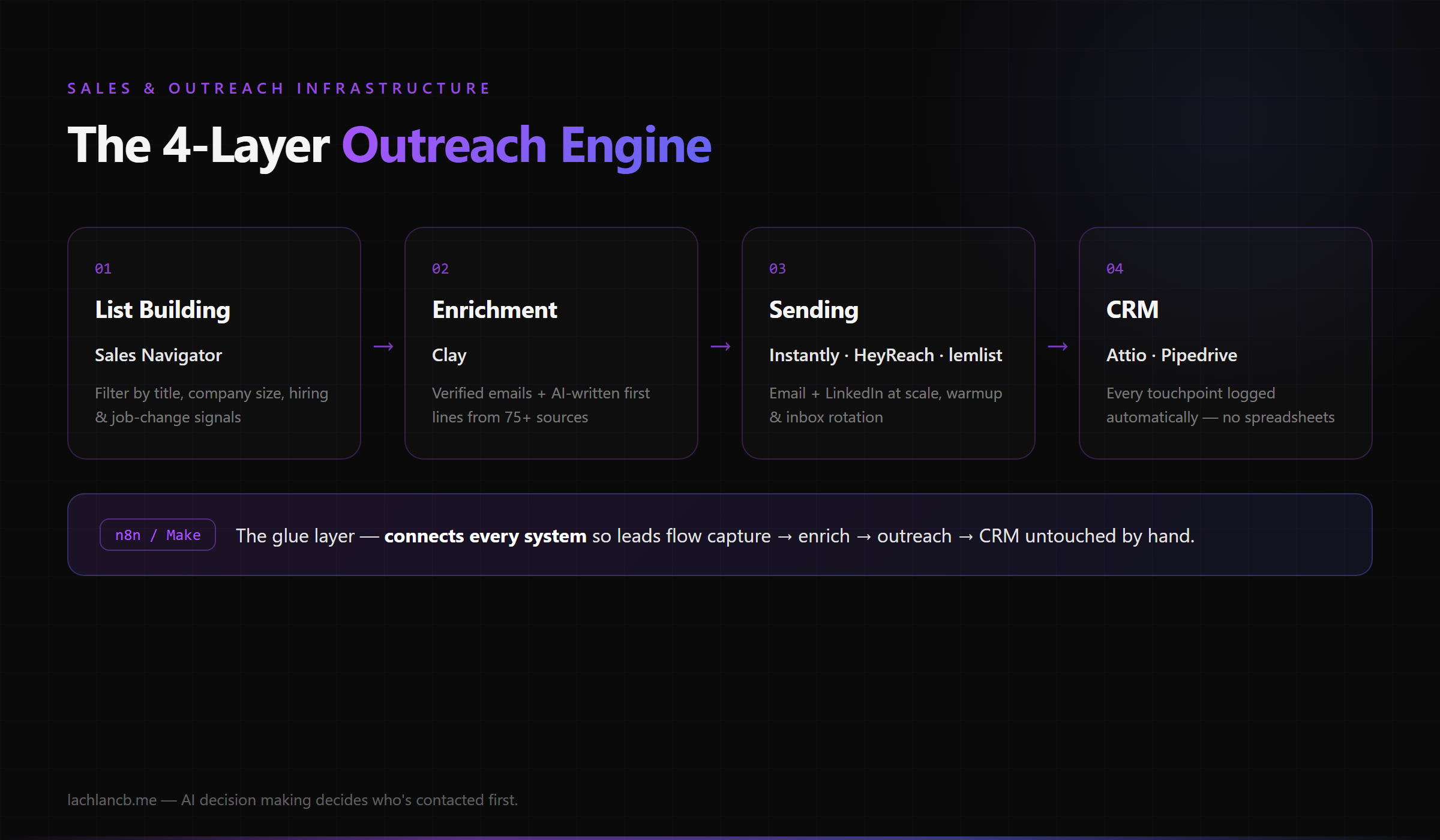
Modern agency outreach runs on four connected layers: list building, enrichment, multichannel sending, and a CRM that logs everything automatically. Get those four talking to each other and outbound stops being a person's job.
Here's the standard architecture, the one most high-performing outbound teams converge on:
- List building — LinkedIn Sales Navigator to filter by title, company size, and hiring signals. This is where every campaign starts.
- Enrichment — Clay as the central engine. It finds verified emails, scores leads, and writes personalised lines using AI.
- Sending — Instantly or Smartlead for email (warmup, inbox rotation, deliverability), HeyReach or lemlist for LinkedIn.
- CRM — a lightweight system like Attio or Pipedrive that logs every touchpoint without manual entry.
The glue is automation — n8n or Make — connecting it all so a lead flows from capture to enrichment to outreach to CRM without anyone touching it. ColdIQ runs this exact pattern across 30+ tools to generate $7M ARR serving 70+ clients — but you don't need 30 tools to start. You need the four layers connected.
One thing AI still can't do here: close. The system books the meeting. You win the deal. That's why sales is the last skill AI can't touch — the infrastructure feeds you conversations, but the human still converts them.
The SaaS Stack You Actually Need
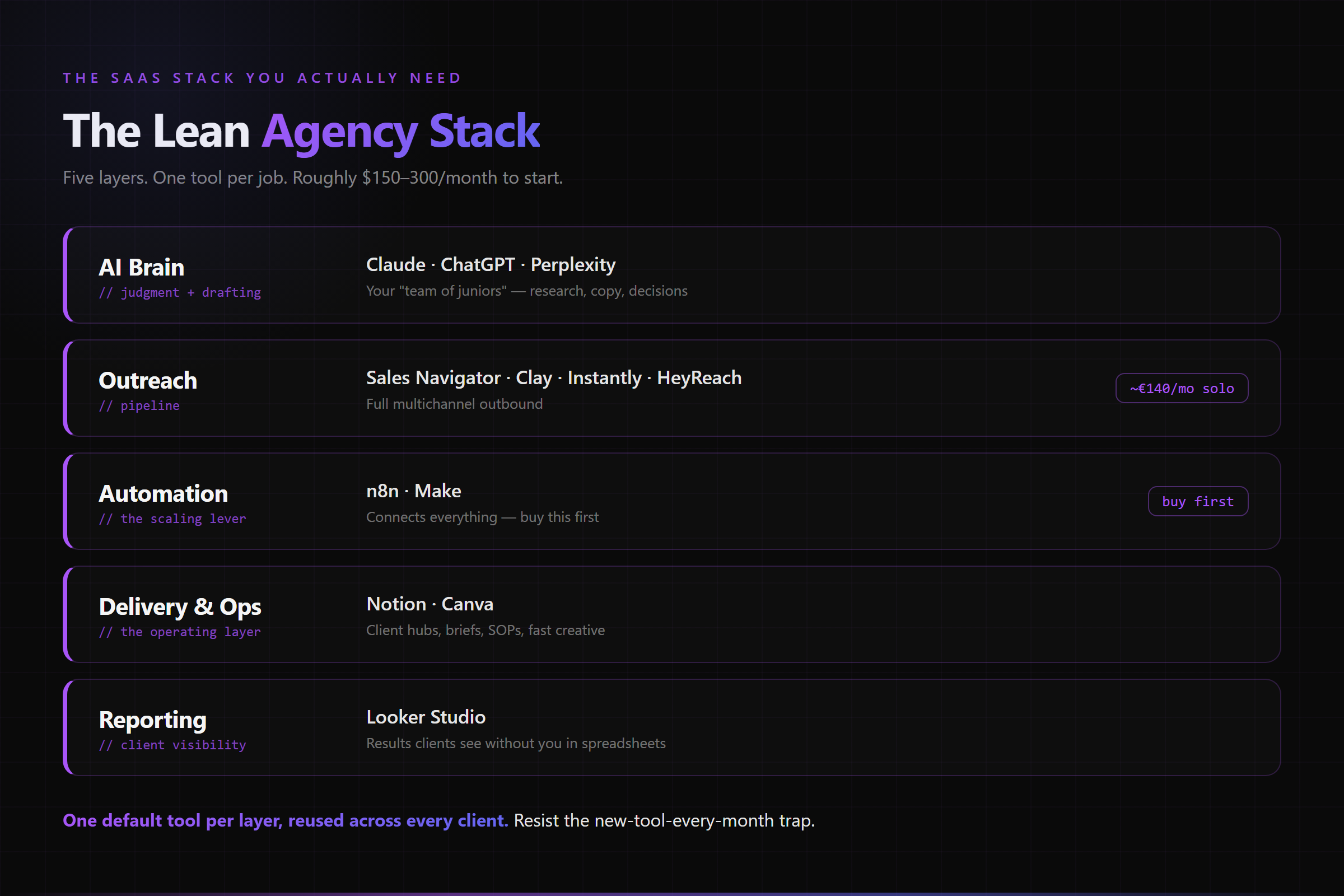
The minimum viable agency stack costs roughly $150–$300 a month and covers five layers: AI brain, outreach, automation, delivery, and reporting. You do not need 30 tools. You need one tool per job, connected.
Here's the lean version — what I'd run if I were starting today:
- AI brain — Claude and ChatGPT for drafting, analysis, and decision support. Perplexity for research with citations. This is your "team of juniors."
- Outreach — Sales Navigator + Clay + Instantly (email) + HeyReach (LinkedIn). A solo operator can run a full multichannel stack for around €140/month; small teams adding Apollo and Clay land near €600/month.
- Automation — n8n (technical, cheap, powerful) or Make (visual, easy). This is the layer that actually scales delivery across clients — buy it first.
- Delivery and ops — Notion as the operating layer (client hubs, briefs, SOPs, trackers). Canva for fast creative.
- Reporting — Looker Studio or a simple dashboard so clients see results without you living in spreadsheets.
The principle that keeps this from sprawling: one default tool per layer, reused across every client. Resist the new-tool-every-month trap. A stack you understand and reuse beats a stack that's "best in class" but disconnected.
Why This Is the Easiest Time in History to Build One
Starting an agency is easier now than ever because the cost of leverage collapsed. The work that used to require capital and headcount now requires a credit card and a weekend.
Think about what got removed. You don't need an office. You don't need a team to start. You don't need to pay a researcher, a copywriter, and a VA before you've earned a dollar. The barrier that used to stop people — the upfront cost of capacity — is gone.
What's left is the part that always mattered: can you find clients, and can you deliver. The leverage is sitting there for anyone willing to assemble it. Most won't, because the stack looks intimidating from the outside. It isn't. It's five layers and a bit of AI decision making to connect them.
The modern agency isn't a smaller version of the old one. It's a different shape entirely — software where staff used to be, judgment where job titles used to be. Build the system, keep the decisions, and one person can do the work of twelve.
FAQ
What is a modern agency?
A modern agency is a lean operation that replaces employees with software and AI decision making. Instead of a large team, it runs on a connected stack — outreach tools, automation, and AI — letting one or two operators deliver what used to take a dozen people.
How much does an agency tech stack cost in 2026?
A minimum viable stack runs roughly $150–$300 a month. A solo outbound setup (Sales Navigator, Clay, an email tool) can start near €140/month. Costs scale with client volume, but the entry point is low enough to start before you have revenue.
What is AI decision making in an agency?
AI decision making is the layer that decides who to contact, what to say, and what happens next — automatically. It scores leads by intent, drafts personalised outreach at scale, and routes work through the pipeline, removing the manual judgment that used to require junior staff.
Do I need a big team to start an agency now?
No. The biggest shift in modern agencies is that headcount is no longer the constraint. Software handles repeatable work and AI handles first-pass judgment, so one person with the right stack can deliver real client results before hiring anyone.
Which tool should an agency buy first?
Automation. A single AI assistant speeds up drafting, but an automation platform like n8n or Make is what actually scales delivery across multiple clients. Start there, then layer outreach and reporting on top.