·5 min read
How to Start a Digital Marketing Agency: Four Years In
A digital marketing agency is a service business that sells marketing delivered through systems. Here is how to start one, from the first client to the first workflow.

A digital marketing agency is a service business that sells marketing delivered through repeatable systems. You can start one with a laptop, one offer and a clear buyer. This is how I would start one again, based on running my own agency for four years.
TL;DR
- Choose one offer and one buyer before you buy any tools.
- Deliver the first clients yourself, and write down every step.
- Turn the repeatable steps into workflows: lead response, onboarding, reporting and reminders.
- Hire only when delivery is what blocks your next sale.
Pick one offer before you pick a name
A broad offer is hard to explain and hard to deliver. A buyer who hears "we do marketing" may have no reason to pick you.
Pick one service and one type of business owner. Write the result you promise in one sentence. If you cannot say it in one sentence, the offer is probably still too wide.
Take your first clients and write everything down
Your first clients teach you a lot. Deliver the work yourself, even when it feels slow. Keep a simple log for each client: what they bought, what you did, what took longest, and where the work got stuck.
That log becomes your delivery process. It is also the list of what to automate next.
Build the repeatable parts as systems
Once the same steps repeat, they belong in a system. Good candidates are lead response, client onboarding, reporting and follow-up reminders. Each one can run as a workflow, not as a task someone remembers to do.
I build with GoHighLevel, n8n and Claude. The point is not the tools. The goal is that a lead gets a response without you watching a dashboard.
Measure the time a workflow saves before you build the next one. A workflow that saves only a few minutes a week may not be worth a long build.
Keep the first hire until delivery blocks sales
I would not hire early. A new person is a cost you carry whether or not the sales are there. Test how many clients you can serve on your own systems before you add anyone.
Hire when the work you are doing is the reason you cannot take another client. Until then, the money is better spent on the systems that make your time go further.
Write the first offer on one page
Before you sell, write the offer on one page. Include what the client gets, what is not included, how often they get reports, and what they must provide, such as account access or a product list. I would list its limits, so the buyer knows what they are paying for.
Keep the first version short. You will probably change it after your first few clients, and a short page is quicker to rewrite.
Build a client intake that asks the right questions
Use one intake form or call script for every new client. Ask four things: what they sell, who buys it, where their leads come from today, and what happens after a lead comes in. The last question is the one that points to where the systems can go.
Save the answers in the same place as the client log. Then the first workflow you build starts from what the client already does, not from a guess.
Track four numbers from the first client
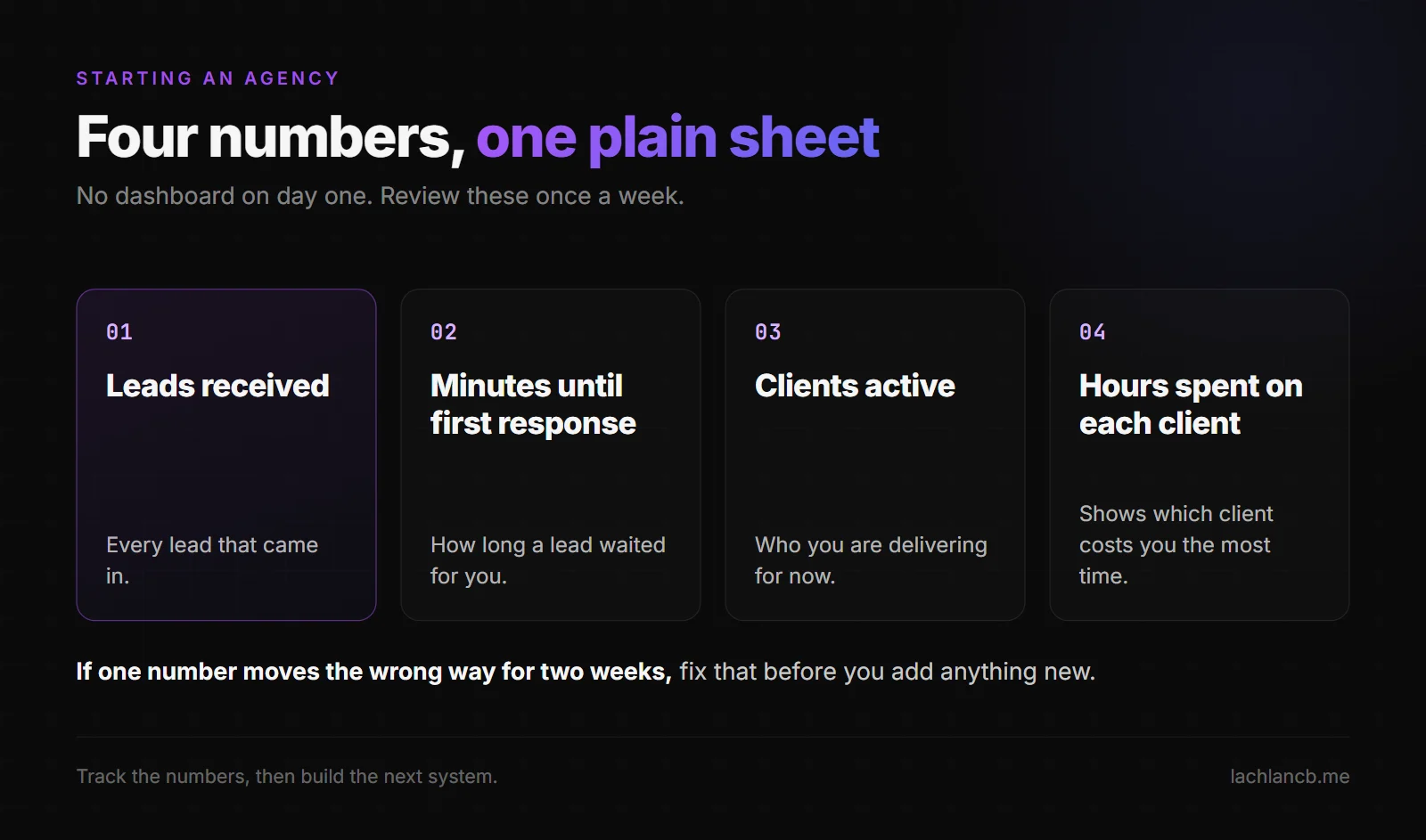
You do not need a dashboard on day one. Track four numbers in a plain sheet: leads received, minutes until the first response, clients active, and hours spent on each client. Those numbers show whether a system is working, and they tell you which client is costing you the most time.
Review them once a week. If one number moves the wrong way for two weeks, fix that before you add anything new.
Budget the software before you sign up
Software is a real cost, and the plan you pick changes what you can do. Check the vendor's own pricing page before you commit, and recheck it when you add clients.
GoHighLevel's pricing page lists three self-serve plans: Starter at $97 a month or $970 a year with three sub-accounts, Unlimited at $297 a month or $2,970 a year with unlimited sub-accounts, and Agency Pro at $497 a month or $4,970 a year. The page also states that SMS, calls and email are usage-based, on top of the plan fee. It does not list the per-message rates, so check those on the vendor's page before you budget for them. Source: gohighlevel.com/pricing, checked 27 October 2026.
n8n's pricing page lists a self-hosted Community edition, which is available on GitHub, and hosted plans. At annual billing, the Starter plan is listed at €20 a month with 2,500 executions, and Pro at €50 a month with 10,000 executions. Source: n8n.io/pricing, checked 27 October 2026. The Community edition has no price listed on that page, but running it means you run the server yourself.
The rule I would follow: do not buy a plan for the client you hope to get. Buy the plan for the clients you have, and move up when the usage shows you need to.
Use your own proof, and only that
Buyers will ask what you have done. Answer with what you have actually delivered: the years you have run the business, the number of clients you have served and the tools you use. Do not borrow results from other agencies or invent a case study to look bigger.
I would rather use specific, honest numbers than vague claims.
Expect slow early months
Early months can be slow. Sales may come in bursts, and some months you may deliver for one client and do all the selling yourself. Use that stage to build the systems.
If you want to see how the same thinking applies once the agency is running, read how to scale a digital marketing agency without hiring. The start is about the first buyer. The scale is about getting delivery off your desk.
Not sure which system to build first? Book an AI discovery call and I'll walk you through it.