·6 min read
Nobody Can Tell It's AI that changes everything.
AI voice agents now hold phone calls most people can't tell are artificial. The real bottleneck isn't quality anymore — it's trust. Here's the model that works.
An AI voice agent is a software system that answers your phone, talks like a person, and runs the call from "hello" to resolution — booking the job, qualifying the lead, or solving the problem without a human on the line.
I've built these for local service businesses. Here's the strange part: the technology already works. The voice is good. The conversations are smooth. The thing holding it back isn't the tech anymore.
It's trust.
TL;DR: AI voice agents can now hold natural phone conversations most people can't identify as artificial. The bottleneck is no longer quality — it's trust. The businesses that win won't fire every human. They'll run AI first and escalate to a person the moment it matters.
What an AI Voice Agent Actually Does
An AI voice agent picks up a call, understands natural speech, and takes action — no keypad menus, no "press 4 for billing."
Under the hood it's a stack: a voice platform like Vapi, a synthesis engine like Eleven Labs for the actual voice, and a CRM like GHL to book the appointment or log the lead. I wire these together for service businesses that miss calls when they're on a job.
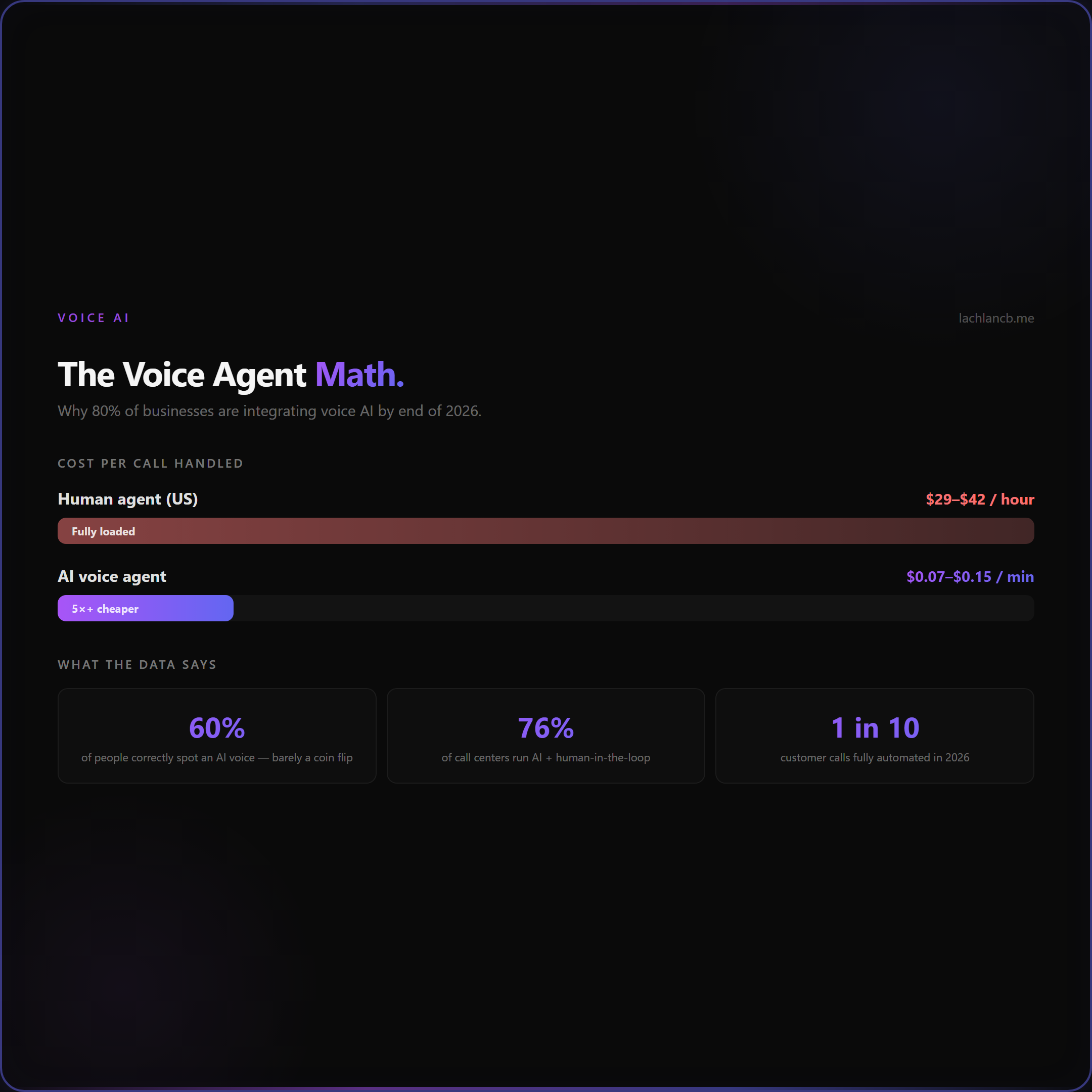
The economics are brutal in AI's favor. A US-based human agent costs $29–$42 per hour fully loaded, while a voice agent runs roughly $0.07–$0.15 per minute. It never sleeps, never has a bad day, and handles ten calls or ten thousand without a hiring cycle.
That's why 80% of businesses plan to integrate voice AI into customer service by the end of 2026.
The Voice Is Already Good Enough to Fool You
Yes — people genuinely cannot tell anymore.
A 2025 study in Scientific Reports tested this with Eleven Labs voice clones. Listeners matched the AI voice to the real person's identity about 80% of the time, and correctly flagged a voice as AI only about 60% of the time — barely above a coin flip. The researchers' conclusion: AI voices "will soon be indistinguishable from real ones."
Sit with where this goes next. Soon you'll clone a specific person's voice and let an agent represent them — your best closer, answering 50 calls at once, in their own voice. The tech for that exists today.
We're heading toward a reality where you won't need to say it's AI. It'll just be a good call.
Why the Trust Gap Still Exists
Because people still flinch the moment they know it's a bot.
This is the part the hype skips. The voice can be perfect, but humans crave human-to-human contact. The second someone clocks "I'm talking to a machine," they brace up. They hold back. They ask for a person.
The data backs the instinct. 76% of contact center leaders now run a "human-in-the-loop" model rather than full automation. And when calls get emotional or high-stakes, 91% stay with a human. Nobody wants a bot handling their grief, their fraud alert, or their cancellation.
This is the same reason sales stays a deeply human skill. Trust doesn't transfer to a voice you don't believe is real.
The Real Model: AI First, Human on Escalation
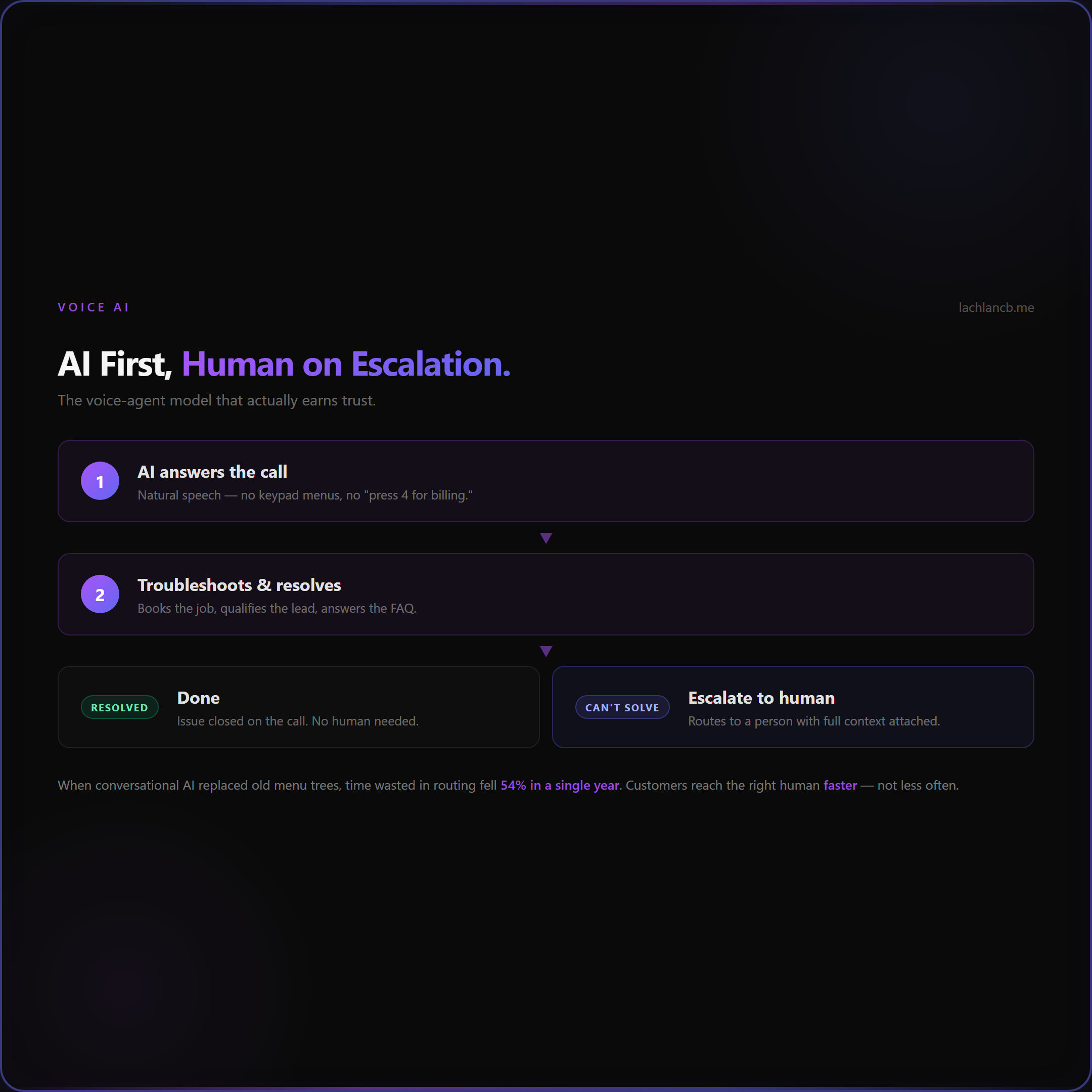
The setup that actually works mirrors a smart support queue. AI picks up, troubleshoots, and resolves what it can. When it hits something it can't handle, it routes to a human — passing the full context so the customer never repeats themselves.
If you've used tiered chat support, you already know the feeling: a bot tries first, a person takes over when the bot stalls. Voice is going the same way. The best handoffs are invisible to the caller.
This isn't a downgrade. It's the upgrade. When conversational AI replaced old menu trees, time wasted in routing fell 54% in a single year. Customers reach the right human faster, not less often.
The mistake is framing it as "AI vs. humans." The winning frame is AI for volume, humans for judgment. I build my whole operation on that split — let the machine absorb the repetitive load, reserve the human for what only a human can do.
What This Means for Customer Service Jobs
A large share of entry-level customer service work is going to disappear — and faster than most people expect.
Gartner projects conversational AI will cut contact center labor costs by $80 billion in 2026 — even though only about one in ten interactions will be fully automated this year. Industry analysts expect AI to eliminate a meaningful share of entry-level support roles within three years.
I won't soften that. The bottom rung of the customer-service ladder is being automated away.
But the ladder doesn't vanish — it shifts up. The humans who stay move to complex problems, escalations, and quality oversight. The repetitive script-reading goes to the machine. This is the same pattern playing out everywhere: the work that survives is the work that needs judgment, not repetition.
If you run a business, the takeaway is simple. Build the voice agent now. Run it hybrid — AI first, human on escalation. Be calm about disclosure. The companies that get this right won't just cut costs. They'll answer every call, at 2am, on a Sunday, while their competitors send it to voicemail.
The voice agent is already answering. The only question is whether it's answering for you or for the business that took your customer's call first.
Frequently Asked Questions
What is an AI voice agent?
An AI voice agent is a conversational system that answers phone calls in natural speech and completes tasks — booking appointments, qualifying leads, or resolving support issues — without a human on the line. It combines a voice platform, a speech engine, and a CRM.
Can people tell they're talking to an AI voice agent?
Often not. A 2025 Scientific Reports study found listeners correctly identified AI voices only about 60% of the time and matched cloned voices to the real person around 80% of the time. Voice quality is no longer the giveaway.
Will AI voice agents replace human customer service?
Not entirely. Most organizations now run a human-in-the-loop model where AI handles high-volume, routine calls and escalates complex or emotional ones to a person. Entry-level roles will shrink, but human judgment stays essential.
How much does an AI voice agent cost?
Roughly $0.07–$0.15 per minute, versus $29–$42 per hour for a fully loaded US human agent. For a business missing calls during jobs, the payback is almost immediate.
Which businesses should use an AI voice agent?
High-call-volume, structured-request businesses benefit first: home services, healthcare scheduling, bookings, and after-hours lead capture. If you regularly miss calls, you're losing revenue a voice agent would catch.