·10 min read
Follow Up Email After No Response: 4 Copyable Templates
A follow up email after no response has to add something new. Here's a 4-touch cold email follow up template, with a copyable email for every touch.
A follow up email after no response is a timed outreach message that gives the recipient a specific new reason to engage — not a restatement of what you already said. Most fail because they add nothing to the original message the prospect already saw and ignored.
TL;DR: Every follow up email after no response must add something the previous message did not: a proof point, a different angle on the value, a relevant trigger, or a clean exit. The cold email follow up template below gives each message a distinct job across four touches. The goal is not persistence — it is showing up with value each time you appear in someone's inbox.
Why most follow up emails after no response fail before they are opened
Most follow-up failures happen before the subject line is even read. The real problem is not visibility or timing — it is that the sender has nothing new to say and the prospect can sense it from the preview text alone.
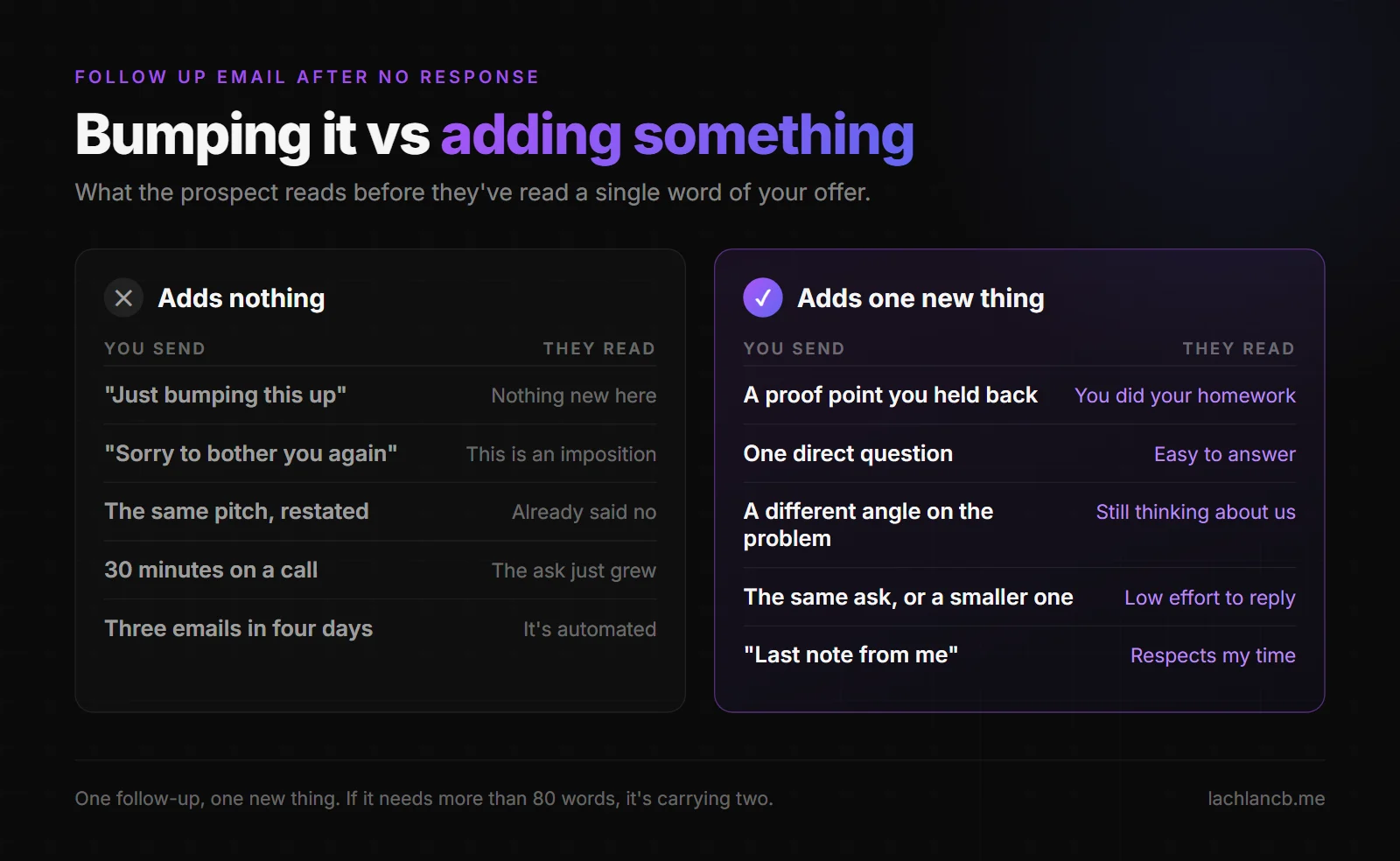
"Just bumping this to the top of your inbox" is the email equivalent of standing at someone's desk and repeating yourself. It signals low status and a fundamental misreading of why the first message went unanswered. The implicit message is: I want something from you, and I am willing to impose on your attention to get it. That lands before a single word of your offer is processed.
Most non-replies happen because the prospect saw the original email, assessed it as not immediately relevant, and moved on — not because it was buried. A follow-up that restates the original pitch adds nothing to someone who already made that assessment. What changes the calculation is new information: a result they did not know about, a frame that makes the problem feel more urgent, or a direct statement that you are done following up.
The counter-intuitive insight is that a well-crafted follow-up can outperform the original outreach — because it arrives with more context, a specific proof point, and the implicit signal that you took the time to write something new rather than forward the same message with a preamble attached.
The timing logic: why spacing matters as much as content
Spacing follow-ups too closely reads as panic. Three emails in four days signals that your pipeline is thin and your outreach is automated. The 3-5 day gaps between touches are not arbitrary — they serve two distinct functions.
First, they give the prospect time to act on the previous message before the next one arrives. A reply that comes the same day as a follow-up was probably already coming regardless — the follow-up did not cause it. The follow-up that converts is the one that surfaces your name when the original thread has gone quiet, with something new attached to it.
Second, proper spacing protects your sender reputation. Inbox providers track engagement signals per domain, and a pattern of rapid-fire unreplied emails will eventually route your messages to spam — affecting not just this prospect but every future recipient from your domain. Patience between touches is a technical requirement, not just a social courtesy.
The 4-touch cold email follow up template
Each touch has one job. The jobs are different by design — because each one is reaching a prospect who has now seen different information than they had before. Use these as copyable templates, adjusting the specifics to your situation.
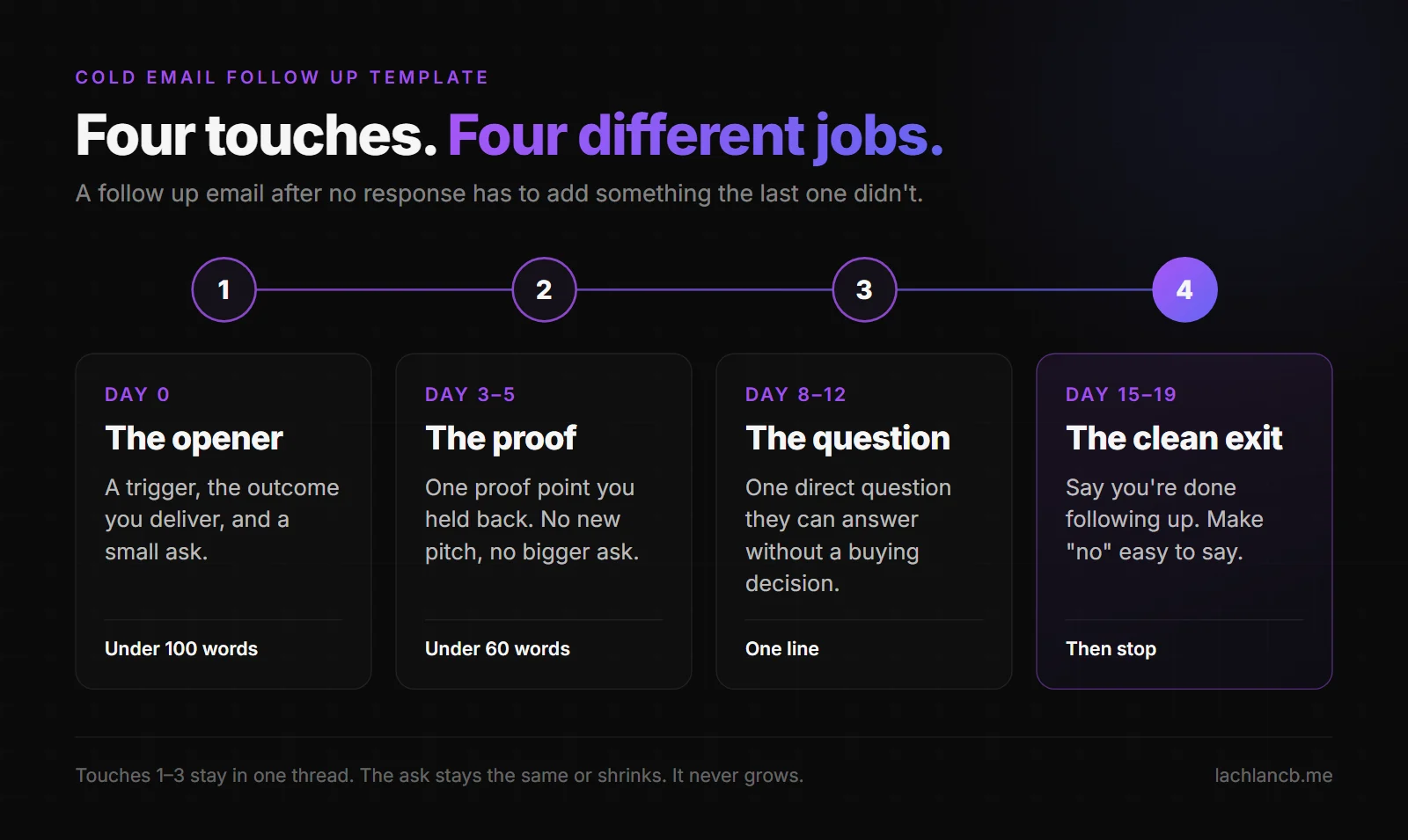
Touch 1 — Original message: Trigger, outcome, micro-ask. Under 100 words. Specific to their situation. (If you have not nailed the opener, read the post on the three-line cold open first. The rest of this cadence only works if the original gives the prospect a real reason to care.)
Touch 2 — Social proof (3-5 days later): Do not restate the original pitch. Add one proof point you held back from the first message: a result, a metric, a customer problem you solved that maps to theirs. Frame it as additional context, not a sales push. Keep it under 60 words. The proof does the work; your commentary should not.
Touch 2 example:
"Thought this might be useful context: [company type similar to theirs] had a similar challenge with [specific problem]. We reduced their [metric] from X to Y in [timeframe]. Not sure if that maps to your situation, but thought it was worth sharing."
Touch 3 — Different angle (5-7 days after touch 2): If you led with time-saving in touch 1 and an efficiency proof in touch 2, approach from a different direction here: revenue risk, competitive exposure, a constraint you have not yet addressed. A direct question almost always outperforms a third pitch angle, because it lowers the activation energy required to reply.
Touch 3 example:
"Quick question — is the harder part the manual work itself, or the lack of visibility into what's happening downstream once it leaves your team?"
A question signals that you are still thinking about their situation, not just running a sequence. It invites a reply that does not require a buying decision, which is why it often converts where a third pitch does not.
Touch 4 — The clean break: Tell the prospect you are not going to follow up again. Make it easy for them to say no. This is the most underused touch in the sequence, and it works because it removes the social pressure that has been quietly accumulating.
Touch 4 example:
"I'll stop here — I don't want to keep landing in your inbox if this isn't relevant. If the timing changes, here's what we help with: [one line]. No action needed."
The clean break works in both directions. It gives genuinely interested prospects permission to re-engage without owing an explanation for the delay. And it closes the loop cleanly for those who are not a fit — which matters for your pipeline clarity as much as for their inbox.
Subject lines for follow-up messages
Keep follow-ups in the same thread through touches 2 and 3. A continuous thread gives the prospect full context without requiring them to search for the original. Changing the subject line on touch 2 looks like a fresh email, which means the prospect has to re-process who you are and why you are emailing them — wasted attention that should be going to your proof point.
Touch 4 is the one case where a fresh subject line can help, particularly if the original thread has become unwieldy. Keep it simple and neutral: something like "[First name] — last note" rather than a repackaged pitch. The goal is a clean exit, not another hook.
Why follow-ups land warmer when you show up elsewhere first
A follow up email after no response lands better when the recipient has already seen your name or face somewhere else, even if they never engaged with that content. A prospect who has scrolled past your LinkedIn post, watched 30 seconds of your YouTube video, or seen you comment in a Facebook group where they lurk is processing your email differently than someone receiving cold contact from a complete unknown.
This is not about building relationships before pitching. It is about reducing the activation energy required to reply. When your name triggers recognition rather than evaluation, the prospect skips the "who is this person and why should I care" step and moves straight to "is this relevant right now." That single-step reduction is often the difference between a reply and a delete.
The tactical implication: if you are running outbound at any scale, showing up on the platforms your prospects actually use (with useful content, not pitches) makes every email in your follow-up sequence perform better. The content does not need to convert on its own. It just needs to make your name feel less foreign when it lands in an inbox.
Before and after: the same follow-up rewritten
BEFORE (restated pitch):
Subject: Re: My earlier email
"Hi Sarah, just wanted to bump this up in case it got buried. We help agencies like yours automate their client reporting. Would love to connect if you have 15 minutes. Happy to work around your schedule."
This message adds nothing. It is a louder version of something she already saw and decided not to act on. It also escalates the ask — 15 minutes of calendar time is a larger commitment than the reply it is trying to generate.
AFTER (proof angle, touch 2):
Subject: Re: Automating your reporting
"One thing I didn't mention — a three-person agency we worked with last quarter cut their monthly reporting time from 14 hours to 2. They were stitching together five tools manually. Not sure if that maps to what you're dealing with, but thought it was worth sharing."
This earns attention. It introduces evidence the prospect has not seen. It does not ask for anything — no call, no reply, no next step. That absence of demand is itself a signal: you are confident enough in the proof that you do not need to push.
Follow-up signals: what to do and what to avoid
| Move | What the prospect reads | Outcome |
|---|---|---|
| "Just bumping this up" | Nothing new here | Ignored |
| Fresh proof point, no ask | You've done your homework | A new reason to reply |
| "Sorry to bother you again" | This email is an imposition | Deleted before reading |
| "Last note from me" + clean exit | You respect their time | An easy yes or a clean no |
| Multiple angles in one message | You're unsure what will land | Overwhelm, no action taken |
Common mistakes in the cadence
Spacing too close together. Three emails in four days confirms the prospect's suspicion that they are in an automated sequence. Give them time to act between messages before the next one arrives.
Changing the ask upward. If you asked for a reply in the original email and escalated to "30 minutes on a call" in touch 2, you have moved in the wrong direction. The ask should stay consistent or shrink. It never grows.
Apologising before asking. "Sorry to bother you again" is a self-fulfilling frame. It tells the reader the message is an imposition before they have had a chance to decide that for themselves. If the follow-up earns its place, write it that way and skip the qualifier.
Stopping after one non-reply. Many replies from cold outreach sequences come from the second or third touch — not the first. Treating a single non-reply as a closed door means you are quitting before the cadence has had a chance to work.
Complete follow up email templates (copy and customize)
Below are all four touches as copyable templates. Replace the bracketed placeholders with your specific situation.
Template 1 — Original outreach (Day 0):
Subject: [Specific trigger relevant to their business]

Hi [Name],

[One sentence showing you know their situation]

[One sentence stating the specific outcome you deliver]

[Micro-ask: Would it make sense to...? / Worth a quick look?]
Template 2 — Proof point (Day 3-5):
Subject: Re: [Original subject]

One thing I didn't mention — [company type similar to theirs] had a similar challenge with [specific problem]. We [specific result with metrics] in [timeframe].

Not sure if that maps to what you're dealing with, but thought it was worth sharing.
Template 3 — Direct question (Day 8-12):
Subject: Re: [Original subject]

Quick question — is the harder part [option A], or [option B that reframes the problem]?
Template 4 — Clean exit (Day 15-19):
Subject: Re: [Original subject] (or "Last note")

I'll stop here — I don't want to keep landing in your inbox if this isn't relevant.

If the timing changes, here's what we help with: [one line summary].

No action needed.
The Follow-Up Sequence Builder walks you through customizing these templates with your specific details. Free, runs in your browser, nothing to book.