·6 min read
Stop Studying, Start Deciding: Why Learning Is Procrastination Now
Online courses will not save you. In the age of AI, learning without building is just procrastination with better branding.
Learning feels productive. You open a course. You take notes. You highlight things. You feel like you are moving forward.
You are not.
You are hiding. And I say that as someone who hid behind "learning" for years before I figured out what was actually happening.
The Comfortable Lie
There is a belief most of us carry: "I need to know more before I can start." It sounds responsible. It sounds wise. It is neither.
It is fear dressed up as diligence.
Online courses, certifications, masterclasses — they give you the feeling of progress without the risk of failure. You finish a module. You get a badge. You tell yourself you are closer to ready.
But ready never comes. Because "ready" is not a destination. It is a stalling tactic. And the more you learn without building, the wider the gap gets between what you know and what you have done.
I spent months consuming content on automation, AI workflows, and systems design before I ever built a single thing. Every course felt like progress. None of it was. The progress started when I opened a blank file and described what I wanted to build.
Why Online Courses No Longer Matter
Here is the uncomfortable truth: traditional structured learning — courses, degrees, workshops — is becoming irrelevant for most practical skills.
Not because the information is bad. Because the delivery model is broken.
A course teaches you what someone else decided you need to know, in the order they decided you need it, at a pace they set. You sit. You absorb. You move through their framework. You learn prerequisites for things you may never use. You study theory for problems you do not have yet.
But AI has inverted this entirely.
You can now design your own learning experience in real time. You describe the problem you are facing right now. The AI explains the concept you need — not the one before it, not the prerequisite, not the theory. Just the thing that unblocks you.
This is not a small shift. This is a fundamental change in how competence is built. The curriculum is no longer designed by an institution. It is designed by you, at the point of need, in the context of a real problem you are solving.
Tom Bilyeu put it bluntly: most people will waste this year the same way they wasted last year — reading books, watching courses, attending workshops — trying to build skills they could delegate to AI tomorrow. The small group that wins will master one skill instead: directing AI to do the work.
You Are the Lead Architect Now
This is the shift that matters. You are no longer a student following a syllabus. You are the architect of what you need to know.
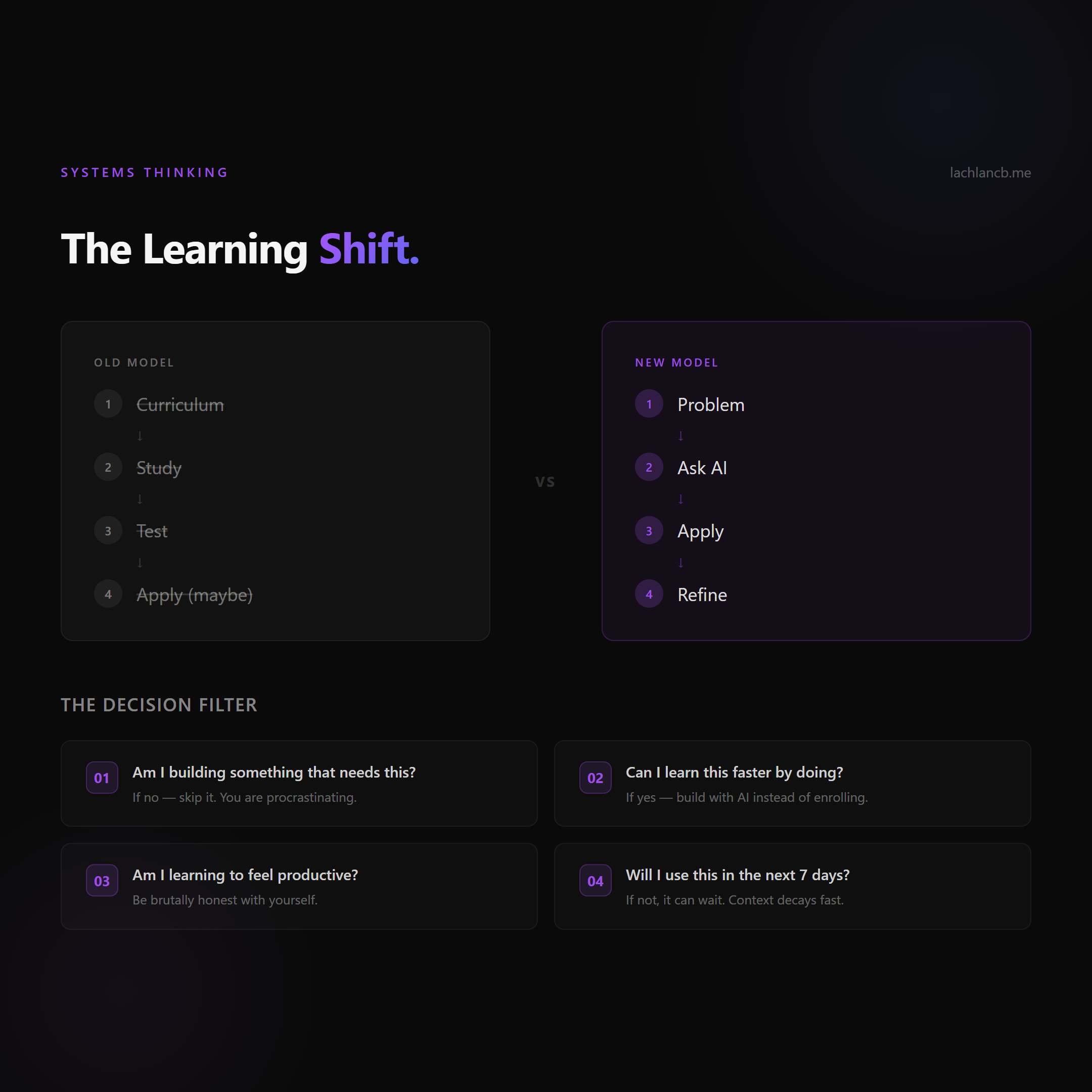
The old model: curriculum → study → test → apply (maybe).
The new model: problem → ask → apply → refine.
You learn by doing. The AI fills gaps on demand. You never sit in a lecture hall — real or virtual — absorbing theory you might use someday. You pull exactly what you need, when you need it, and you move on.
This is not about skipping learning. It is about compressing it. You still learn. You just learn at the point of need, not the point of enrollment.
I build things every week I have no formal training in. Voice agents. Automated CRM workflows. Content systems that draft, publish, and cross-post across four platforms. Server automation scripts that run infrastructure without me touching a terminal. I did not study any of it in a classroom. I described the problem, asked the right questions, and built.
The learning happened inside the building. Not before it.
The Performance Paradox
There is a real risk here, and I want to name it honestly.
Researchers at the Australian Network for Quality Digital Education found what they call the "performance paradox" — students using AI perform better on immediate tasks, but their durable learning drops. In one study of nearly 1,000 students, AI users scored higher on assignments. Remove the AI, and the understanding simply was not there.
The mechanism is simple: AI bypasses the struggle that builds lasting understanding. The output looks right, so you assume you learned something. You did not. You just watched.
This matters. If you use AI as a replacement for thinking, you will get weaker over time. If you use AI as a partner in building — where you direct, evaluate, and refine — you will get sharper.
The difference is whether you are directing or consuming. Consuming is passive. Directing is a skill. And it is the only skill that compounds in this new environment.
The Decision Filter
Here is how I think about it now. Before I "learn" anything, I run it through a simple filter:
- Am I building something that needs this? If no — skip it. You are procrastinating.
- Can I learn this faster by doing it with AI? If yes — do that instead of enrolling in a course.
- Am I learning to feel productive, or to solve a real problem? Be brutally honest with yourself.
- Will I use this in the next 7 days? If not, it can wait. Context without action decays fast.
Most "learning" fails the third question. It is procrastination with better branding. You feel like you are working. You are not. You are avoiding the uncomfortable part — the part where you put something out into the world and risk it being imperfect.
Feeling Like You Need to Know Enough Is the Trap
This is the deepest version of the lie. The belief that there is a threshold of knowledge you need to cross before you are allowed to act.
There is not.
Every founder, builder, and operator I respect started before they were ready. They made decisions with incomplete information. They built things that were rough. They shipped before it was polished. And they learned faster than anyone sitting in a course ever could — because the feedback was real, not simulated.
The tools available today make this even more true. You do not need to understand every layer of a system to build on top of it. You need to understand the problem clearly, direct the tools well, and iterate based on what happens.
That is AI and decision making in practice. Not studying decision frameworks in a textbook. Making real decisions, with real stakes, using real tools, and learning from what works and what does not.
What This Means for You
If you are sitting on three half-finished courses right now, stop. Close the tabs.
Pick one thing you want to build. Not learn about — build. Open an AI tool. Describe what you want. Start the conversation. Let the tool teach you what you need to know as you go.
You will learn more in two hours of building than in two weeks of coursework. And you will have something real to show for it — not a certificate, not a badge, but a working thing that solves a problem.
The age of studying your way to competence is over. We are in the age of deciding your way to competence. Pick the problem. Build the solution. Learn what you need along the way.
The people who win from here are not the most educated. They are the most willing to decide and act before they feel ready.
Stop studying. Start deciding.