·5 min read
Skills Are Not Important Anymore. Here’s What Is.
Skills used to define your career. Now they’re downloadable. Here’s how to find yourself again when everything you learned can be automated.
There was a pattern we all followed. Go to school. Learn something. Get a job doing that thing. Get better at it over time. Get paid more.
That pattern is breaking — fast.
I’m watching it happen in real-time from my terminal. And if you’re wondering how to find yourself again in a world where your hard-won skills can be replicated by a prompt, you’re not alone. Business Insider reported in March 2026 that software engineers are already facing an identity crisis as AI takes over more of the actual coding. But this isn’t just about engineers. It’s about everyone.
The Old Model Is Dead
Here’s how it used to work:
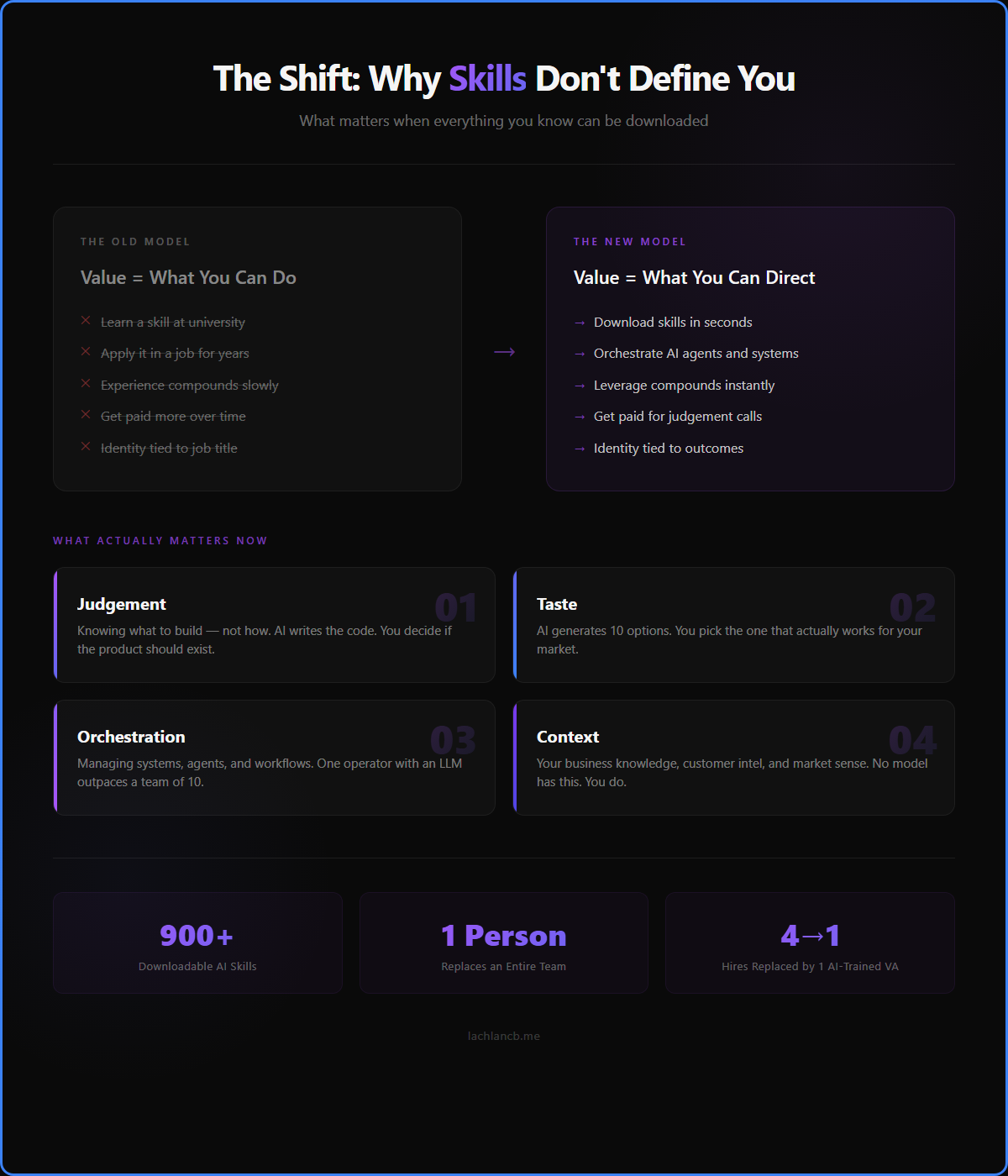
- You learn a skill (university, apprenticeship, YouTube tutorials)
- You apply that skill in a job
- Over time, your experience compounds
- You get paid more because you’re harder to replace
That last part — being hard to replace — was the whole game. Your value was tied to what you could do that others couldn’t.
Now? I have over 900 skills installed in my Claude Code setup. Not metaphorical skills. Literal downloadable capabilities. Each one replaces what used to be a specialist role:
- Back-end development — API design, database migrations, server management
- Front-end development — React patterns, UI/UX, responsive design
- Content design — SEO writing, social media posts, carousel generation
- Operations — deployment pipelines, monitoring, automation workflows
- Sales systems — cold email sequences, CRM automation, proposal generation
One person. One terminal. The work of an entire team.
There are open-source repositories on GitHub with over 13,000 stars and 1,000+ community-built agent skills. These aren’t toys. They’re production-grade capabilities that anyone can install in seconds.
The Identity Problem Nobody Talks About
This creates a problem that goes deeper than job loss.
When your identity is built on what you do — “I’m a designer,” “I’m a developer,” “I’m a marketer” — and a machine can now do that thing, who are you?
AI anxiety isn’t a skills problem. It’s an identity crisis. The fear isn’t really about learning new tools. It’s about losing the thing that made you you in a professional context.
I think the next generation is going to feel this hardest. They’ll enter a workforce where the traditional path — learn, apply, earn — no longer compounds the way it used to. The gap between “I can do this” and “an AI can do this faster” keeps shrinking.
What Actually Matters Now
If skills are commoditised, what’s left?
Judgement. Knowing what to build, not just how to build it. An AI can write the code, but it can’t tell you whether the product should exist in the first place.
Taste. Understanding what good looks like. An AI generates 10 options. You need to know which one actually works for your audience, your brand, your market.
Orchestration. The ability to manage systems, agents, and workflows. This is the new leverage. One person with strong orchestration skills and an LLM can outpace a team of 10 who are still doing everything manually.
Context. AI is powerful but generic. You have context about your business, your customers, and your market that no model has. The person who feeds the right context into the right system wins.
The Rich Get Richer (But Not How You Think)
Here’s where it gets uncomfortable.
The people who already understand leverage — business owners, operators, system thinkers — are about to pull even further ahead. Not because they’re smarter. Because infrastructure is now trivially cheap to build.
Need a dashboard? Built in a day. Need a content pipeline? Automated by Thursday. Need a sales system? Configured by the end of the week.
The highest-leverage play I’ve seen emerging: hiring a VA trained in AI tools like Claude Code. One person who knows how to operate these systems can handle day-to-day across content, ops, development, and sales. In the past, that was four hires. Now it’s one.
AI isn’t destroying jobs. It’s exposing that most white-collar work was never truly meaningful. The meaningful part — the thinking, the deciding, the leading — that’s what remains.
How to Find Yourself Again
If you’re reading this and feeling the ground shift, here’s what I’d actually do:
- Stop identifying with your skill. You’re not “a developer” or “a designer.” You’re a problem solver who currently uses those tools. The tools will change. You won’t.
- Learn to operate, not just execute. The gap is no longer between “can code” and “can’t code.” It’s between “can manage a system that codes” and “can only code manually.”
- Build context that AI can’t replicate. Deep customer relationships. Industry-specific knowledge. Local market understanding. Taste refined over years of real-world feedback.
- Get comfortable with orchestration. Learn one AI tool deeply. Understand prompting, workflows, and how to chain capabilities together. This is the new literacy.
The old model rewarded accumulation — more skills, more years, more certificates. The new model rewards integration — connecting the right capabilities to the right problems at the right time.
Skills are downloadable now. But you are not.
FAQ
Is AI really replacing all jobs?
No. AI is replacing tasks, not jobs. The jobs that survive will shift toward decision-making, client relationships, and system management rather than manual execution.
What skills should I learn in 2026?
Focus on orchestration (managing AI tools and workflows), judgement (knowing what to build), and domain expertise (deep context AI can’t replicate). The specific technical skill matters less than your ability to direct it.
How do I stay relevant as a solo operator?
Learn one AI-powered system deeply — Claude Code, Cursor, or similar. Use it to replace the tasks you used to outsource. Your advantage is speed and context, not headcount.
Will AI tools replace VAs and freelancers?
Partially. A VA trained in AI tools is now worth more than a specialist who isn’t. The role shifts from “do the work” to “operate the system that does the work.”