·5 min read
Stop Learning, Start Building: The New AI Edge
The gap between people who build and people who wait is not skill. It is willingness. Why action beats theory in the age of AI tools.
There is a quote I keep coming back to: "The willingness to figure things out as you go is often the only difference between people who build something and people who just talk about it."
It used to be half-true. You still needed skills. You needed years of reps. You needed to understand the stack, the syntax, the system.
That era is ending.
We now live in a time where the tools are so powerful that the gap between "I have an idea" and "I have a working thing" has collapsed. And the only variable left standing is whether you are willing to sit down and start.
The Death of "Learn First, Build Later"
For most of modern business, the playbook was linear. Learn the skill. Get certified. Practise for years. Then — maybe — go build something.
AI broke that sequence.
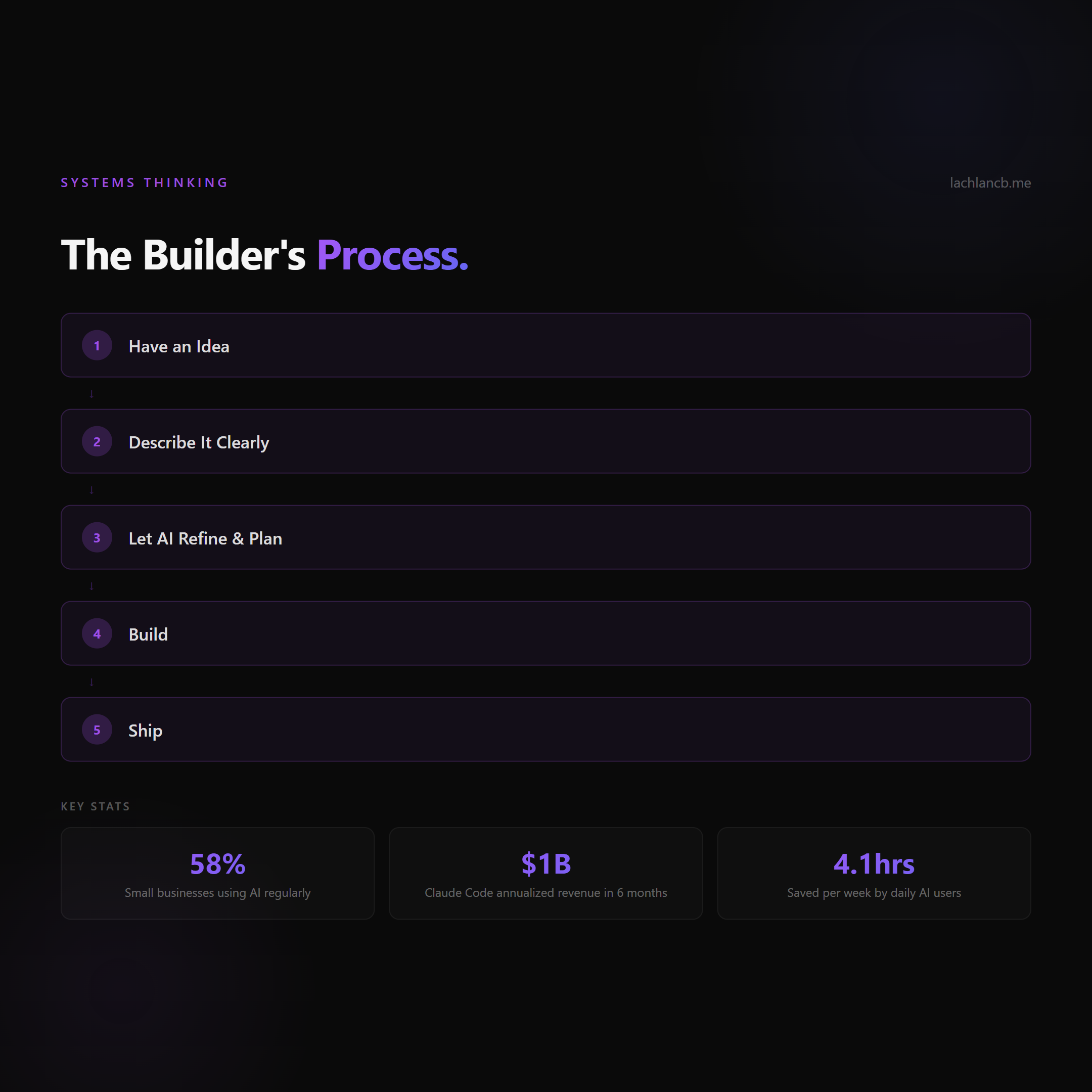
Claude Code hit $1 billion in annualized revenue within six months of launch. Its development lead publicly stated that for 30 consecutive days, 100% of his coding tasks were handled by the AI. Not assisted. Handled.
58% of small businesses started using AI tools regularly in 2025. And 20% of solopreneurs now earn between $100,000 and $300,000 annually — without a single employee.
The barrier to building is not knowledge anymore. It is initiative.
What I Have Built Without "Knowing How"
I want to be honest about what this looks like in practice. Because it is not theoretical for me.
In the last few months, using Claude Code with skills and agents, I have built:
- A full demo site generator for my agency — prospects get a custom preview site in minutes
- Automated daily briefings that pull from my calendar, CRM, and news sources
- A content system that drafts, publishes, and cross-posts across four platforms
- Voice agents that handle intake calls for service businesses
- VPS automation scripts that run my entire infrastructure without me touching a server
I did not study web development to build the demo generator. I did not take a DevOps course to set up the VPS automation. I described what I wanted, brainstormed the approach with the AI, let it plan the architecture, and then executed.
The process now looks like this: have an idea → describe it clearly → let the tool refine and plan → build → ship.
That is it. The old middle steps — learn the framework, read the docs, debug for hours, ask Stack Overflow — are compressed or gone.
Why Understanding Matters Less Than It Used To
This is the part that makes people uncomfortable. We have been taught that understanding is sacred. That you should never use a tool you do not fully comprehend.
But the tools have changed. They are not dumb hammers anymore.
When I ask Claude Code to build something, it does not just generate code. It researches the best approach. It considers edge cases. It writes tests. It explains what it did and why. The understanding is embedded in the tool itself.
The leverage is being pushed forward even without full context of what you are working with. And that is not a bug. That is the feature.
The landscape has fundamentally shifted from "writing code" to "directing intelligence." You do not need to be the expert. You need to be the director.
The Real Skill Now: Clear Thinking
None of this means thinking does not matter. It means the type of thinking that matters has changed.
The premium skill is no longer technical execution. It is:
- Problem definition — Can you articulate what needs to exist?
- Quality judgment — Can you tell when something is good enough versus when it needs another pass?
- Sequencing — Do you know what to build first?
- Taste — Can you tell the difference between something that works and something that works well?
These are human skills. And they do not require a degree, a certification, or three years of experience. They require the willingness to sit with a problem and think clearly about it.
The Gap Is Not Skill. It Is Willingness.
I talk to people every week who have better ideas than me. Smarter strategies. Deeper domain knowledge.
They have not built anything.
Not because they lack tools. Not because they lack time. Because they are waiting until they "know enough." Until they have taken the course. Until they feel ready.
Ready is a trap. The people building things right now are not more talented. They are more willing to start before they feel qualified.
The AI does not care about your credentials. It cares about your instructions. Give it clear direction and it will do remarkable work. Give it nothing and it sits there, same as it does for everyone else.
What This Means Going Forward
The practical desire to learn is being replaced by the practical desire to apply. And I think that is a good thing.
Learning for the sake of learning is a luxury. Learning by building is a lever.
If you have been waiting to start something — a product, a system, an agency, a side project — the barriers you think exist probably do not. The tools are here. The cost is near zero. The only question left is whether you are willing to figure it out as you go.
Most people will not be. That is your edge...