·7 min read
Operator and Architect: Two Modes That Build Everything
The operator grinds. The architect designs. The people who build things that last know how to switch between both — deliberately, on demand.
Most people operate in one mode. They are either building or thinking. Doing or planning. Executing or reflecting.
The problem is not that one mode is better than the other. The problem is that most people get stuck in one and never switch.
The operator grinds. The architect designs. And the people who actually build things that last are the ones who know how to move between the two — deliberately, on demand, without waiting for permission or the right moment.
What Is an Operator?
The operator is the mode you are in when you are doing the work. Sending the emails. Writing the code. Running the calls. Shipping the feature. Posting the content.
Operators move fast. They bias toward action. They would rather do something imperfect now than plan something perfect later. In a world that rewards speed and volume, the operator is essential.
But the operator has a blind spot: repetition without reflection. The operator does not ask "is this the right thing to do?" They ask "what is the next thing to do?" And there is always a next thing. So they keep going.
Left unchecked, the operator becomes a machine running in a loop. Busy every day. Productive by every visible metric. But quietly stuck — doing the same things, getting the same results, wondering why nothing is compounding.
What Is an Architect?
The architect is the mode you are in when you step back. You stop doing and start designing. You look at the system from above instead of from inside it.
Architects ask different questions: Is this the right workflow? What would I build if I started over? Where is the bottleneck I keep working around instead of fixing? What should I stop doing entirely?
The architect is the one who redesigns the machine — not because it is broken, but because it could work better. They slow down to retool so they can go farther and faster later.
But the architect has a blind spot too: overthinking. Architects can spend weeks designing a system they never build. They refine the plan. They question assumptions. They research alternatives. And while they are designing the perfect workflow, someone else ships a rough one and learns from real feedback.
Left unchecked, the architect becomes a theorist. Beautiful diagrams. Zero output.
The Real Power: Knowing When to Switch
The people who build lasting things are not pure operators or pure architects. They are both. They move between modes deliberately, based on what the situation demands.
This is what thinking in systems actually looks like in practice. It is not about having a systems thinking framework on a whiteboard. It is about recognising which mode you are in right now and asking: is this the right one?
Here is how I think about it:
- When I am stuck or busy but not growing — I switch to architect mode. I stop doing and start looking at the system. Where is the loop? What is the bottleneck? What would I redesign?
- When I have been planning or reflecting too long — I switch to operator mode. I pick one thing, build it, and ship it before I talk myself out of it.
- When something is working — I stay in operator mode and protect the rhythm. Do not over-optimise things that are already producing results.
- When something breaks or stops working — I switch to architect mode and figure out why, not just patch it.
The switch is the skill. Not the operating. Not the architecting. The switching.
How They Tangle Together
In practice, these two modes are not clean. They bleed into each other constantly.
You are in operator mode, cranking through your weekly content. Halfway through, you realise the format is not working anymore. The engagement is flat. Do you keep going (operator) or pause and redesign the format (architect)?
You are in architect mode, mapping out a new CRM automation workflow. You have the blueprint. But you keep refining it. Adding edge cases. Tweaking the logic. Do you keep designing (architect) or start building with what you have (operator)?
The tangle is where most people lose time. They half-switch. They "think about it" while still doing the old thing. Or they start building the new thing but keep second-guessing the design.
The fix is simple but hard: commit to the mode. When you switch to architect, stop doing. When you switch to operator, stop questioning. Give each mode your full attention, then switch cleanly.
Case Examples
Content systems. I was posting content every day. Pure operator mode. Volume was high, quality was inconsistent, and nothing was compounding. I switched to architect mode for one afternoon. Mapped out which platforms mattered, what format worked best on each, and built a system that drafts, reviews, and publishes across four channels. Back to operator mode — but now the machine is better.
Client onboarding. I was onboarding each client manually. Same emails, same forms, same setup calls. Operator mode, every time. I switched to architect mode and built a templated onboarding flow in my CRM — automated welcome sequence, intake form, Calendly link, task assignments. Took half a day. Saved hours every week after that.
Weekly reflection. Every Sunday I switch to architect mode for 30 minutes. I review what I built, what worked, what did not. I ask: what would I redesign if I were starting this week from scratch? Then Monday, back to operator. This rhythm prevents me from drifting into busy-but-stuck mode for weeks without noticing.
Using Both to Your Advantage
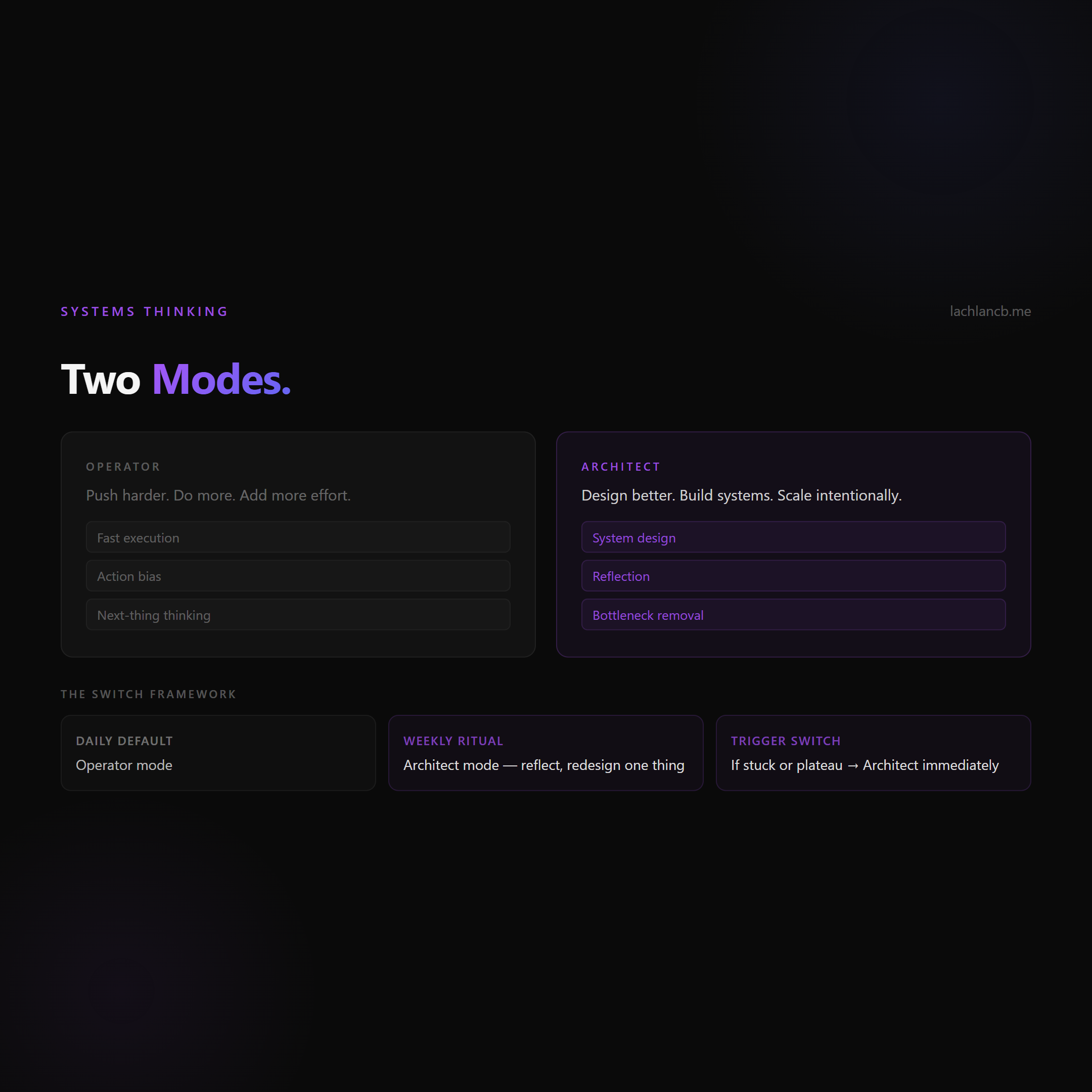
The framework I use is simple:
- Daily default: operator mode. Do the work. Ship. Execute.
- Weekly ritual: architect mode. Reflect. Review. Redesign one thing.
- Trigger-based switches: if something breaks, if results plateau, if I feel busy but not productive — switch to architect immediately. Do not wait for the weekly review.
This is not a personality thing. You are not "an operator" or "an architect." You are a person who can use both modes. The question is whether you do it deliberately or by accident.
Most solopreneurs I talk to are stuck in operator mode. They are proud of being "doers." They wear busyness as a badge. But they have not redesigned anything in months. Their systems are the same. Their output is the same. Their results are the same.
A few are stuck in architect mode. They have plans, frameworks, and Notion databases for everything. But they have not shipped anything in weeks. The plan keeps getting more detailed. The product keeps not existing.
What This Means Going Forward
As AI tools get more powerful, the operator mode gets cheaper. AI can execute tasks, draft content, write code, automate workflows. The raw doing is increasingly handled by machines.
What becomes more valuable is the architect mode — the ability to see the system, identify what matters, decide what to build, and direct the tools to do the work.
But here is the catch: you cannot be a good architect without time spent as an operator. You need to have done the work to know what is worth automating. You need to have felt the bottleneck to know where to redesign.
The future belongs to people who can do both. Operate when it is time to ship. Architect when it is time to redesign. Switch cleanly. Switch often. And never get stuck in one mode for so long that you forget the other one exists.
Think in systems. Build like an operator. Design like an architect. And know which one you need to be right now.
Architect mode gets easier to live in when your tools run themselves. For how that plays out day to day, see Your Next Management System Isn't an App — It's Claude Code — the management system that executes, not just stores.