·5 min read
How I Replaced My Backend Team With One AI Tool
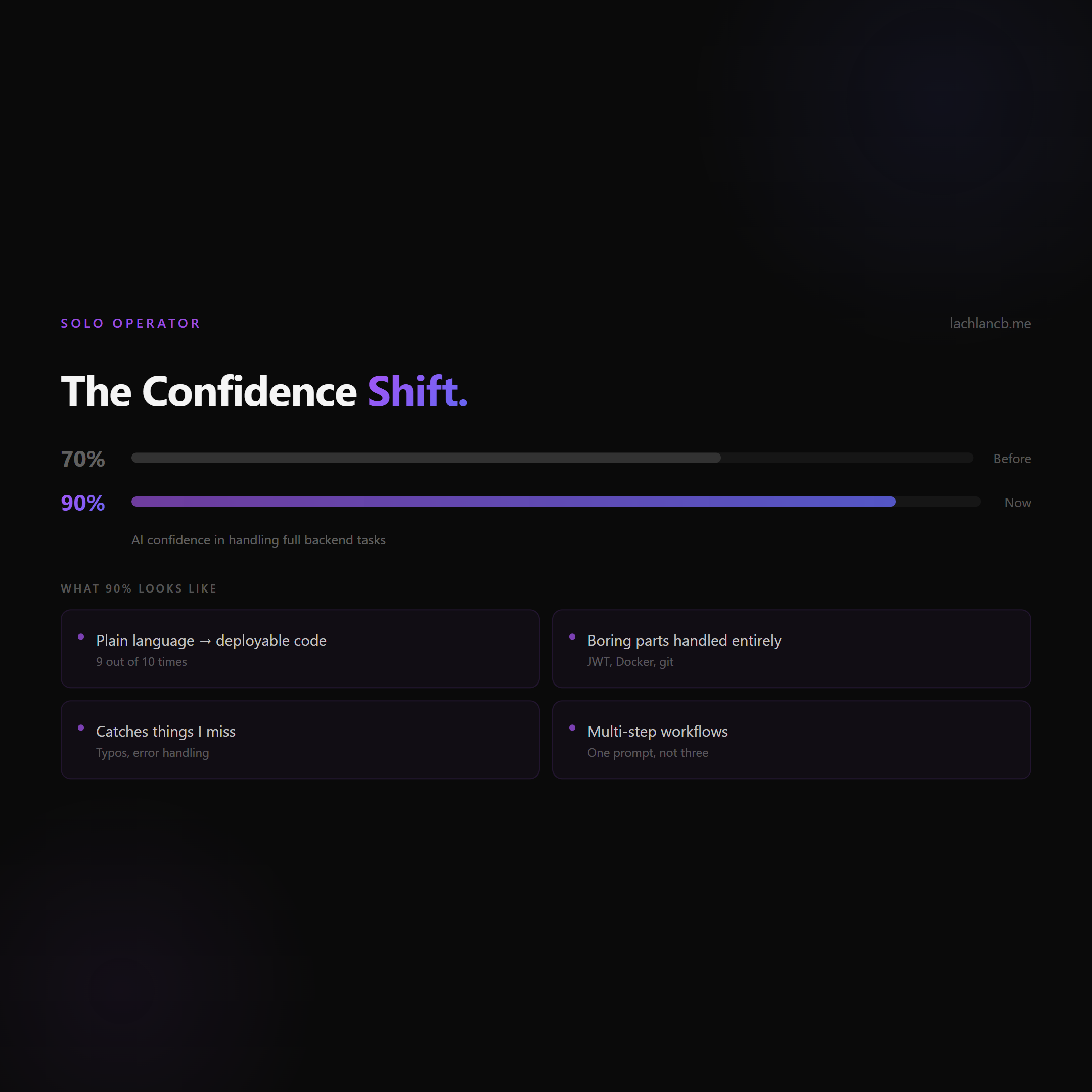
3 months ago I was 70% confident with AI dev tools. Claude Code changed that — now it handles my backend, learns my stack, and executes at 90%.
Three months ago, I was maybe 70% confident that AI could handle real development work for me. Not toy projects. Not "write me a function" prompts. Actual backend infrastructure — APIs, database connections, deployment scripts, automation workflows.
I'd been using Claude Code for solopreneurs-type tasks — scaffolding projects, debugging, writing one-off scripts. Useful, but it felt like having an intern who could type fast. I still had to architect everything, hold the context, and double-check most of the output.
That's changed. And the shift happened faster than I expected.
What Changed in Three Months
The gap between "helpful assistant" and "actual backend team" closed when Claude Code started connecting directly to the tools I use every day.
API integrations. Database queries. Docker containers. Git workflows. SSH into my VPS. Not through copy-pasting code snippets — through direct execution. It reads my files, understands my stack, runs commands, and iterates on errors in real time.
That's a different category entirely. It's not "AI that writes code." It's AI that ships code.
For a solo operator, that distinction matters. I don't have a CTO to review my architecture decisions. I don't have a DevOps engineer to fix my Docker networking at 11pm. Claude Code fills those gaps — not perfectly, but at a level where I can move forward instead of being blocked.
The confidence shift from 70% to 90% isn't about the AI getting marginally better at generating syntax. It's about the integration layer — the fact that it now operates inside my environment, not outside it.
The Skills System Is the Real Unlock
Here's what most people miss about Claude Code: it has a skills and memory system that compounds over time.
Every time I solve a problem — how my n8n webhooks are structured, how my Ghost API auth works, what my deployment flow looks like — that context gets encoded. Next time I work on something similar, it already knows.
This isn't just "chat history." It's operational memory:
- It knows my VPS is a Digital Ocean droplet in Singapore
- It knows my n8n webhook URL format has a quirk that breaks if you use the standard pattern
- It knows I use
uvnotpip, and it doesn't ask twice - It remembers that my Webflow CMS has specific field names that don't match the defaults
The more I use it, the less I explain. The less I explain, the faster I execute. That's the compounding loop.
I've started thinking of it less like a tool and more like a co-pilot that's been onboarded. It went through the messy first few weeks where nothing worked smoothly, and now it just... knows the codebase.
What 90% Confidence Actually Looks Like
Let me be specific about what "90% confidence" means in practice, because it's not "it does everything perfectly."
It means:
- I can describe what I want in plain language and get working code 9 out of 10 times — not pseudocode, not almost-right, but deployable.
- It handles the boring parts entirely. JWT auth, API boilerplate, Docker compose configs, git operations — I don't touch these manually anymore.
- It catches things I miss. Typos in environment variables. Missing error handling. Incorrect API versioning. It's a second pair of eyes that never gets tired.
- It executes multi-step workflows. "SSH into the VPS, rebuild the LangGraph container, and verify the health endpoint" — that's one prompt, not three.
The remaining 10% is where human judgment still matters: architecture decisions, product strategy, knowing when to build vs. when to buy. The thinking work. Which, honestly, is exactly where I want to spend my time.
Why This Matters for Solo Operators
If you're running a business alone — or with a tiny team — your biggest constraint isn't ideas or even money. It's execution bandwidth.
Every hour you spend debugging a Docker networking issue or figuring out why your API returns a 401 is an hour you're not spending on the work that actually grows the business. Sales calls, content, strategy, client delivery.
Claude Code for solopreneurs isn't about replacing developers. It's about removing the bottleneck between "I know what to build" and "it's built."
That's leverage. Real, compounding leverage.
The best version of a solo business isn't one person doing everything. It's one person deciding everything — and systems doing the rest.
Is Claude Code reliable enough for production work?
For the stack I run — Python, Node, Docker, n8n workflows — yes. I deploy code it writes directly to my VPS. The key is the iterative loop: it writes, tests, fixes, and re-tests within the same session.
How long before it "learns" your setup?
Within 2-3 sessions of working on the same project, it picks up your patterns — file structure, naming conventions, tool preferences. The memory system accelerates this significantly.
Does it replace hiring a developer?
For a solopreneur doing 80% of dev work in-house, it replaces most of the tasks you'd hire a junior-to-mid dev for. Senior architecture decisions still need human judgment.
What's the learning curve?
If you're already comfortable with a terminal and basic dev concepts, the curve is shallow. The biggest shift is learning to delegate clearly — same skill you'd need managing a human developer.
The Shift
Three months ago, I was the bottleneck in my own business. Every technical task required my hands on the keyboard, my context in my head, my time on the clock.
Now the heavy lifting happens in the background. I describe the outcome, Claude Code handles the path, and I review the result. The system gets smarter. The execution gets faster. The leverage compounds.
If you're a solo operator sitting on ideas because you can't execute fast enough — the tools have caught up. The question isn't whether AI can build for you. It's whether you're willing to let it.