Last Updated: April 2026
Claude Design is an AI-powered design tool that generates wireframes, design systems, and high-fidelity prototypes from plain text prompts — and it just made a large portion of junior UI/UX work redundant.
TL;DR: Claude Design, launched April 17, 2026, can produce branding books, wireframes, and design systems from a single prompt. A $10,000 web design project now costs closer to $1,000. The skill that matters now is knowing what good looks like — not knowing how to build it.
I used it last week to create a branding book for a friend. No brief, no agency, no rounds of stakeholder meetings. Just a prompt. It came back with something better than what a full-time UI/UX designer had produced for a client of mine six months prior.
That stopped me cold.
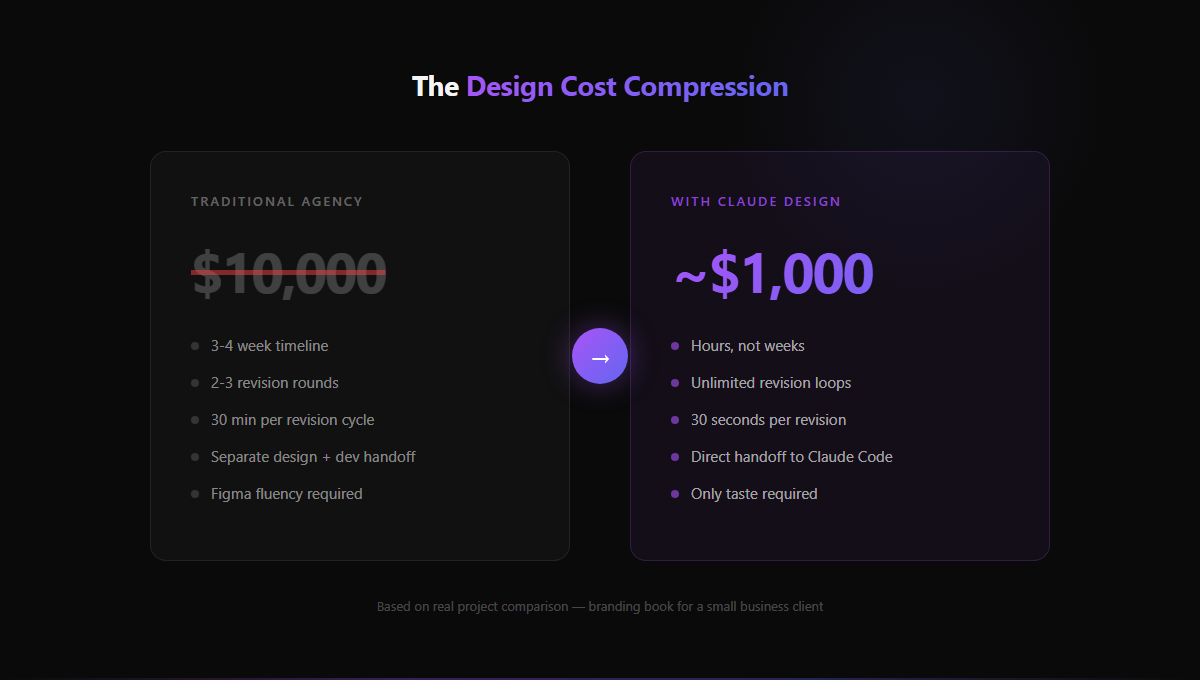
This is not a "AI will take your job" panic piece. It is a systems observation. When a tool compresses a $10,000 deliverable into a $1,000 one — and does it faster — the market reprices. Fast. Skills are not important anymore. Here's what is.
What Claude Design Actually Is
Claude Design is Anthropic's dedicated design layer, launched April 17, 2026, powered by Opus 4.7. It handles design systems, wireframes, high-fidelity prototypes, and direct handoff to Claude Code for implementation. It is not a plugin. It is not a wrapper. It is a full design surface built into the Claude ecosystem.
When it launched, Adobe dropped 1.5% and Figma slid 7% in secondary trading. The market understood immediately what this meant.
What It Can Actually Do
- Generate full design systems from a text description
- Produce wireframes and high-fidelity prototypes without a single drag-and-drop
- Hand off directly to Claude Code for build
- Iterate fast — revisions take seconds, not hours
Real UX/UI testing from DesignerUp confirms it can build design systems from scratch and produce prototypes ready for developer handoff. The workflow compression is real.
The Design Industry Just Got Repriced
Anyone who has hired a web designer in the last five years knows the gap between what was charged and what was delivered. A $10,000 website project often meant three weeks of back-and-forth, two rounds of "creative direction," and a Figma file you could not touch without breaking.
Claude Design collapses that. Not perfectly. Not yet. But directionally, the trajectory is clear.
As Webiano Digital put it: "It will change where the work starts." That is the key insight. The work no longer starts with a designer opening Figma. It starts with a founder, a marketer, or a strategist typing a prompt.
The $10K to $1K Compression
When I used Claude Design to build a branding book, the output required more revision cycles than a senior designer would have needed. But here is the thing: each revision took thirty seconds. Not thirty minutes. The cost of iteration collapsed so completely that the extra rounds did not matter.
That is the model. More loops, faster loops, lower total cost. The economics of design just changed permanently.
I replaced my backend team with one AI tool. The same logic is now hitting design.
Anyone Can Wireframe From a Prompt Now
The barrier to entry for design work was always tool fluency. Figma has a learning curve. Adobe XD had a steeper one. Design systems required taste, but they also required time — hours of component work before anything looked like a real product.
That barrier is gone.
TechTiper described it directly: "Designing is becoming as straightforward as typing a text message." That is not hype. I watched it happen in real time.
What This Means for Non-Designers
If you can describe what you want, you can now get something close to what you mean. That is new. Before, the gap between what a founder imagined and what appeared on screen required a skilled interpreter — the designer. Claude Design is that interpreter. It is not perfect. But it is fast, cheap, and improving.
- Founders can produce first-draft wireframes before briefing an agency
- Marketers can generate landing page concepts without waiting on a designer queue
- Operators can build internal dashboards and tools without a UI contract
The people who get this first will move faster than those who do not.
The Skill That Now Matters: Knowing What Good Looks Like
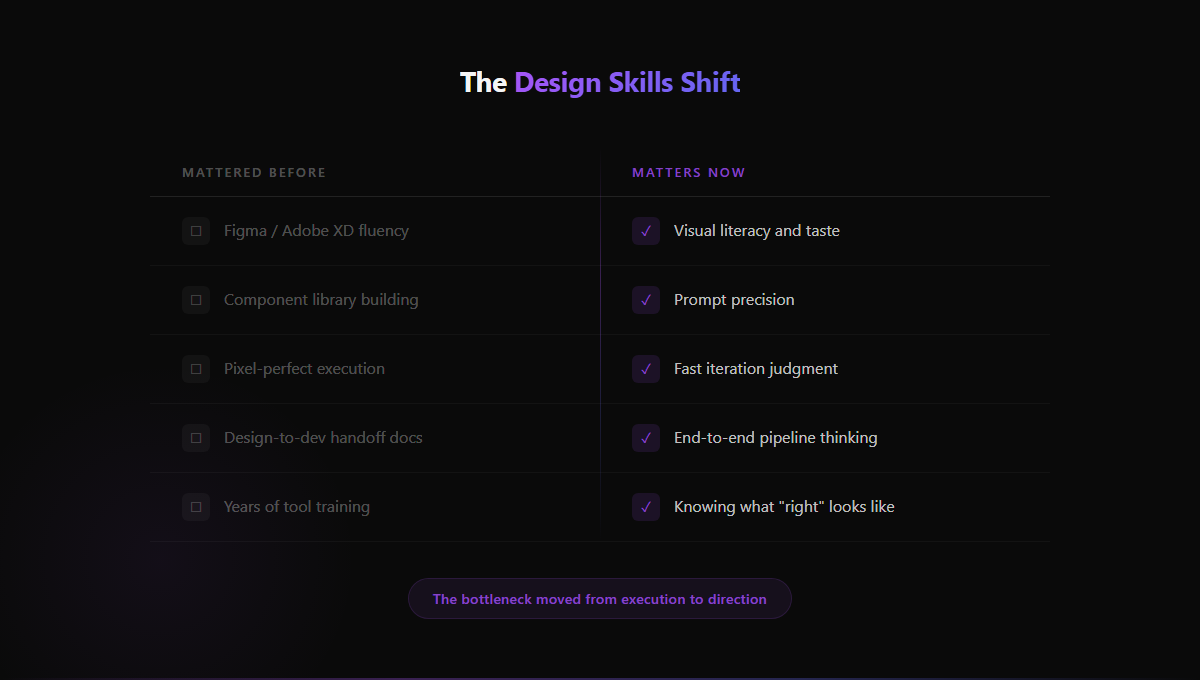
This is the shift that most people miss. The bottleneck was never creativity. It was execution. Now that execution is automated, the only differentiator left is taste — the ability to look at output and know whether it is right.
That is not a technical skill. It is a judgment skill. And it is not evenly distributed.
Most people cannot articulate why a design feels off. They cannot name the type hierarchy problem or explain why the spacing creates visual noise. Claude Design will produce ten options. Knowing which one is right — and why — is now the entire job.
What to Actually Develop
- Visual literacy: Study brand systems, not just tools. Look at what premium companies produce and ask why it works.
- Prompt precision: The difference between a mediocre output and a strong one is how well you describe what you want. This is a learnable skill.
- Iteration speed: The tool is fast. Your judgment needs to match that pace. Learn to give direction quickly.
- Handoff logic: Understand enough about how design connects to code to manage the Claude Design to Claude Code pipeline end-to-end.
I covered a version of this in how I run my entire agency from one terminal window. The pattern is the same: the tool does the execution. Your job is direction and judgment.
Claude Design vs. What Came Before
It is worth being honest about limitations. Claude Design is not magic. It reminds me of early ChatGPT — impressive, genuinely useful, but not yet consistent enough to ship without review. Revisions are necessary. Edge cases fail. Complex multi-brand systems still need a human eye on them.
But ChatGPT got better. Fast. Claude Design will follow the same arc.
The question is not whether it replaces designers. The question is what kind of design work will still require a human in eighteen months. My working answer: strategy, brand positioning, and the judgment calls that require cultural context. Everything else is in play.
The designers who survive this are not the ones who are best at Figma. They are the ones who can direct an AI system, evaluate its output against a brief, and ship faster than the market expects.
Frequently Asked Questions
What is Claude Design and how does it work?
Claude Design is Anthropic's AI-powered design tool, launched April 17, 2026, built on the Opus 4.7 model. It generates wireframes, design systems, and high-fidelity prototypes from plain text prompts. It connects directly to Claude Code for implementation handoff, removing the gap between design and build.
Will Claude Design replace UI/UX designers?
It will replace a significant portion of execution-level design work — wireframing, component building, first-draft design systems. Senior designers who focus on strategy, brand direction, and judgment will adapt. Junior designers doing commodity work are at immediate risk. The repricing has already started: Figma dropped 7% in secondary trading on launch day.
How much does Claude Design cost compared to hiring a designer?
Early evidence suggests projects that previously cost $10,000 with a designer can now be completed closer to $1,000 using Claude Design, even accounting for iteration rounds. The cost of each revision is near zero, which changes the economics of the entire engagement model.
Is Claude Design good enough to use professionally right now?
It is good enough for first drafts, branding books, wireframes, and internal tools — with human review. It is not yet reliable enough to ship production design systems without an experienced eye on the output. It is improving quickly. Treat it as an accelerant, not a full replacement, for now.
What skills do I need to use Claude Design effectively?
Visual literacy and prompt precision matter most. You need to be able to describe what you want clearly and evaluate the output against that brief. Technical tool skills — Figma, XD, Sketch — matter far less than they did twelve months ago. Taste and direction are the new design competencies.
The Bottom Line
Claude Design is not a Figma competitor. It is a category shift. The work of design — the hours of component-building, the wireframe iteration, the design system documentation — is now a prompt away.
The market repriced immediately. The question is whether your positioning has.
If you are a designer: stop protecting tool fluency and start developing judgment. If you are a founder or operator: start using this now, before your competitors figure out that a $1,000 website is available and they are still quoting you $10,000.
The skill is no longer making the thing. The skill is knowing what the thing should be.
Start with one project. One prompt. See what comes back. Your baseline for what design costs just changed permanently.
Written by Lachlan — agency operator, systems builder, and solopreneur based in Thailand. Follow along at lachlancb.me.

Read next
My AI Learns From Its Own Mistakes. Here's the Architecture.
Five layers of self-learning infrastructure that make Claude Code remember failures, preserve context, and get smarter every session.

Claude Code + Obsidian: The Closest Thing to a Limitless Pill
How I turned Obsidian into Claude Code's long-term memory — a limitless-style second brain my AI agents pull from in milliseconds, instead of re-researching every task.