·7 min read
The Rule of 100: Why Volume Beats Strategy Every Time
100 primary actions every day for 100 days. No frameworks, no funnels. Just volume, consistency, and feedback loops that build mastery.

There is a rule I keep coming back to. Not because it is clever. Because it works.
The Rule of 100: do 100 primary actions every day, for 100 days straight.
That is it. No frameworks. No funnels. No strategy decks. Just volume, consistency, and the willingness to show up before you see results.
What the Rule of 100 Actually Is
The concept comes from Alex Hormozi. The idea is dead simple: pick one high-leverage action and do it 100 times a day for 100 consecutive days. If you do cold outreach, that is 100 emails or calls. If you create content, that is 100 minutes a day producing and publishing. If you run ads, that is $100 a day in spend.
The promise is equally simple: if you commit to this, you will generate more engaged leads than you know what to do with. You will never go hungry again.
Most people hear this and think it sounds exhausting. It is. But here is what they miss: the volume is not the point. The volume is the vehicle for something much more valuable — feedback.
Why 100 Days of 100 Actions Builds Feedback
When you do something once, you get one data point. When you do it ten times, you start to see patterns. When you do it 100 times a day for 100 days, you have 10,000 data points. That is enough to see what works, what does not, and why.
Most people never get enough reps to build real feedback loops. They try something for a week, decide it is not working, and pivot. They never reach the threshold where the signal separates from the noise.
100 days of 100 actions forces you past that threshold. By day 30, you know what is landing. By day 60, you are refining. By day 100, you have a system that runs on pattern recognition, not guesswork.
This is thinking in systems applied to action. You are not just doing more. You are building a machine that learns from its own output.
Choose Your Strongest Leverage Point
The rule only works if you pick the right action. Not any action — the highest-leverage action available to you right now.
High leverage means: one input creates disproportionate output. Not all actions are equal. Sending 100 cold emails is high leverage. Reorganising your CRM tags is not. Publishing 100 minutes of content is high leverage. Tweaking your website footer is not.
The question is: what is the one action that, done 100 times today, would move the needle most?
For some people, the answer is obvious. If you have no leads, the answer is outreach. If you have leads but no trust, the answer is content. If you have trust but no conversions, the answer is sales conversations.
For others, it is less clear. That is where self-assessment becomes critical.
Find Your 100 Actions: A Self-Assessment
Before you commit to 100 days, you need to identify where your biggest gap is. Ask yourself these questions honestly:
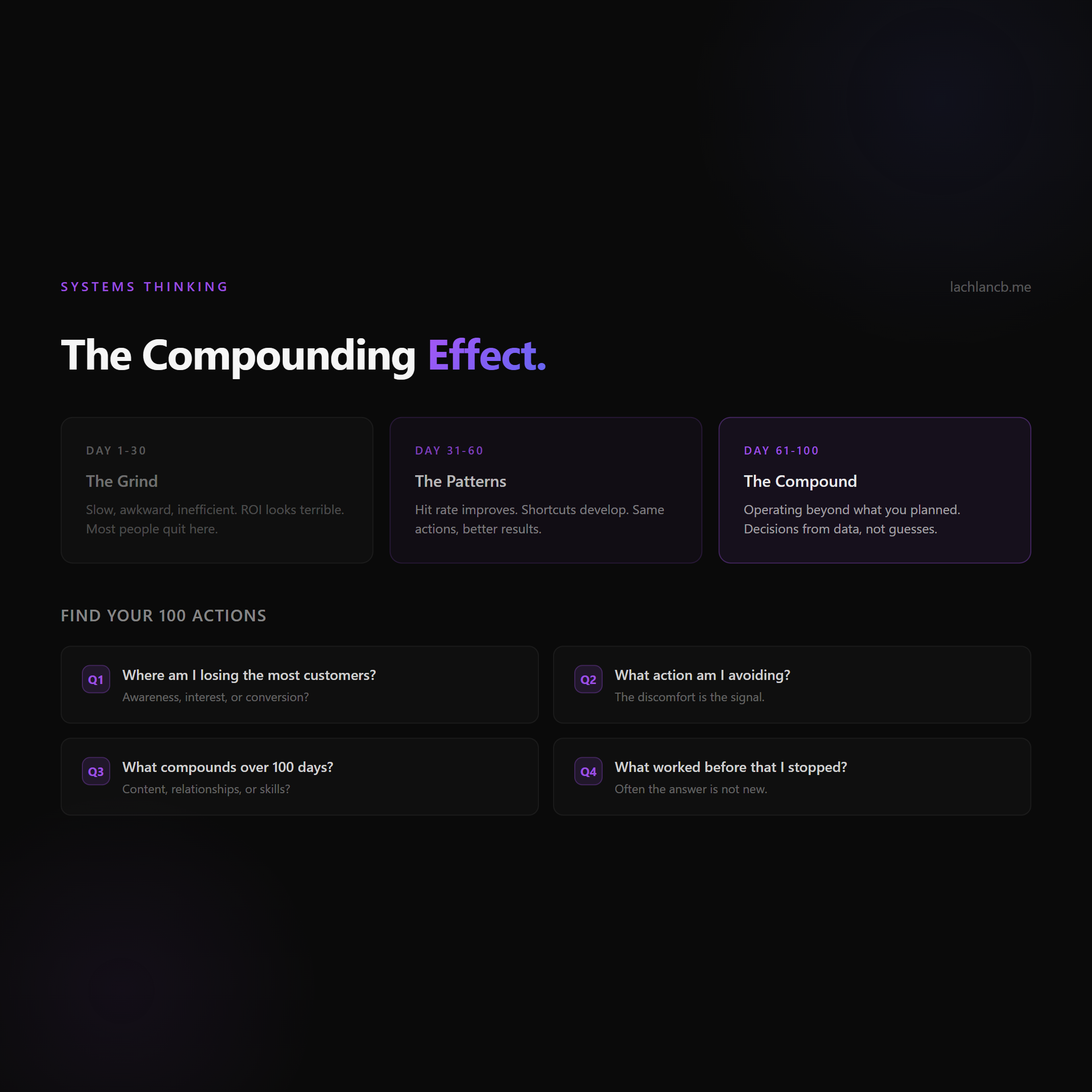
- Where am I losing the most potential customers right now? Is it awareness (nobody knows I exist), interest (they know but do not care), or conversion (they care but do not buy)?
- What is the one action I keep avoiding because it is uncomfortable? That is usually the highest-leverage one. Cold calls. Publishing daily. Asking for referrals. The discomfort is the signal.
- If I could only do one thing for the next 100 days, what would create the most compounding value? Content compounds. Relationships compound. Skills compound. Pick the one that builds on itself.
- What has worked before that I stopped doing? Often the answer is not something new. It is something you already proved works but abandoned because it felt repetitive.
Your answers will point you to your 100 actions. Do not overthink it. The whole point is that volume and consistency beat strategy every time.
My Rule of 100: Claude Code for 100 Days
For me, the rule of 100 was not about outreach or content. It was about building with AI.
I used Claude Code every single day for over 100 days. Not casually. Deliberately. Building something, shipping something, breaking something, fixing something. Every day.
On day 1, I did not know what I was doing. I was copy-pasting prompts and hoping for the best. By day 30, I understood how it thought. By day 60, I was building full automation workflows. By day 100, I had an entire infrastructure — voice agents, CRM automations, content systems, server deployments — that I could not have imagined on day 1.
The learning did not come from a course. It came from 100 days of doing the thing. Each day built on the last. Each mistake became a lesson that compounded into the next session.
That is the rule of 100 in action. You do not need to understand the tool. You need to use the tool — relentlessly, daily, until the understanding emerges from the repetition.
What Makes a Primary Action "Primary"
Not every action qualifies. A primary action has three characteristics:
- Direct impact on revenue or growth. It either brings in leads, builds trust, or closes deals. If it does not do one of these three things, it is not primary.
- Uncomfortable to do at volume. If it feels easy, it is probably not high enough leverage. The discomfort is what keeps your competitors from doing it.
- Measurable. You need to know if you hit 100. "Working on marketing" is not measurable. "Sent 100 outreach messages" is.
Examples of primary actions:
- 100 cold emails or DMs per day
- 100 minutes creating and publishing content
- 100 minutes of sales calls or follow-ups
- $100/day in paid advertising
- 100 minutes building a product or system that serves customers
Examples of things that are not primary actions:
- Reorganising your workspace
- Reading about marketing
- Designing a logo
- Setting up a new tool
- Planning your content calendar (planning is not doing)
The Compounding Effect
The magic of the rule of 100 is not linear. It is exponential.
Day 1-30: you are bad at the thing. You are slow, awkward, and inefficient. Most people quit here because the ROI looks terrible.
Day 31-60: you start to notice patterns. Your hit rate improves. You develop shortcuts. The same 100 actions take less time and produce better results.
Day 61-100: you are operating at a level you could not have planned for. The skill has compounded. The feedback loops are tight. You are making decisions based on thousands of data points instead of guesses.
This is why most people never experience the full power of any strategy. They quit during the linear phase, before the compounding kicks in.
What This Means for You
Pick one thing. The highest-leverage action you can identify right now. Commit to doing it 100 times a day (or 100 minutes a day) for 100 consecutive days.
Do not wait until you feel ready. Do not optimise the strategy first. Do not read another book about it. Just start.
By day 30, you will know more about your market, your product, and your own capabilities than any course could teach you. By day 100, you will have built something that compounds — not just leads, but skill, confidence, and systems that run without you thinking about them.
The rule of 100 is not a hack. It is a commitment to volume that creates the conditions for mastery. And it works every single time for anyone willing to actually do it.
100 actions. 100 days. Start tomorrow.