·8 min read
The 5,000 SaaS Trap: Why Subscriptions Are Dying in 2026
Most SaaS products shipping today are wrappers around APIs. AI coding tools are making them obsolete. Here is what is dying, what still has a moat, and why one-time purchases are making a comeback.
Six months ago, shipping a SaaS was a flex. You'd see indie hackers on Twitter posting their launch day screenshots, their MRR milestones, their Product Hunt rankings. And honestly? It was impressive. Building something people pay for monthly is hard.
But I'm watching something shift in real time, and I think a lot of SaaS builders are about to get blindsided by it.
Most of the SaaS products that launched in 2025 aren't really products. They're wrappers. A UI layer on top of someone else's API. A dashboard that pulls from Stripe. A "content tool" that's really just a prompt feeding into GPT-4. An analytics thing that repackages Google Analytics data.
The value was never in the technology. It was in the packaging. Making something accessible to someone who couldn't build it themselves.
That's the part that's dying.
What a "Wrapper SaaS" Actually Is
Let me be specific, because not all SaaS is created equal.
A wrapper SaaS takes an existing API or service, puts a UI on it, and charges a monthly fee. The product isn't the technology — it's the interface. You're paying for convenience, not capability.
Examples you've probably seen:
- AI writing tools that are just OpenAI's API with a text editor around it
- Social media schedulers that use the same APIs available to anyone
- Analytics dashboards that repackage Google Analytics or Plausible data
- Email tools that are thin layers over SendGrid or Postmark
- "Automation platforms" that are drag-and-drop interfaces for Zapier-style webhooks
None of these products have a technical moat. The API they wrap is available to everyone. The only advantage was: most people couldn't build the interface themselves.
That advantage is evaporating.
The Build-It-Yourself Moment
Here's what changed: AI coding tools made custom software trivial to build. Not easy — trivial. I'm not talking about no-code drag-and-drop stuff. I'm talking about real applications, built to your exact specifications, in hours instead of months.
I use Claude Code to run most of my agency operations from a terminal. Dashboards, automations, content pipelines, CRM workflows — all custom, all built for exactly how I work. Six months ago, I would've needed three separate SaaS subscriptions to do what one afternoon of AI work now handles.
That's the problem for wrapper SaaS. When anyone with a laptop can build a custom version of your product in a day, your monthly subscription stops making sense.
And it's not just technical people doing this. I've seen marketers, founders, and freelancers with zero coding background spin up custom internal tools using AI coding assistants. The skill floor has dropped to almost nothing.
The Economics Don't Work Anymore
Let's do some quick maths.
Say you're paying for five SaaS tools at an average of $29/month each. That's $145/month, or $1,740/year. Over three years, you've spent over $5,000 renting tools that do 30% of what you actually need.
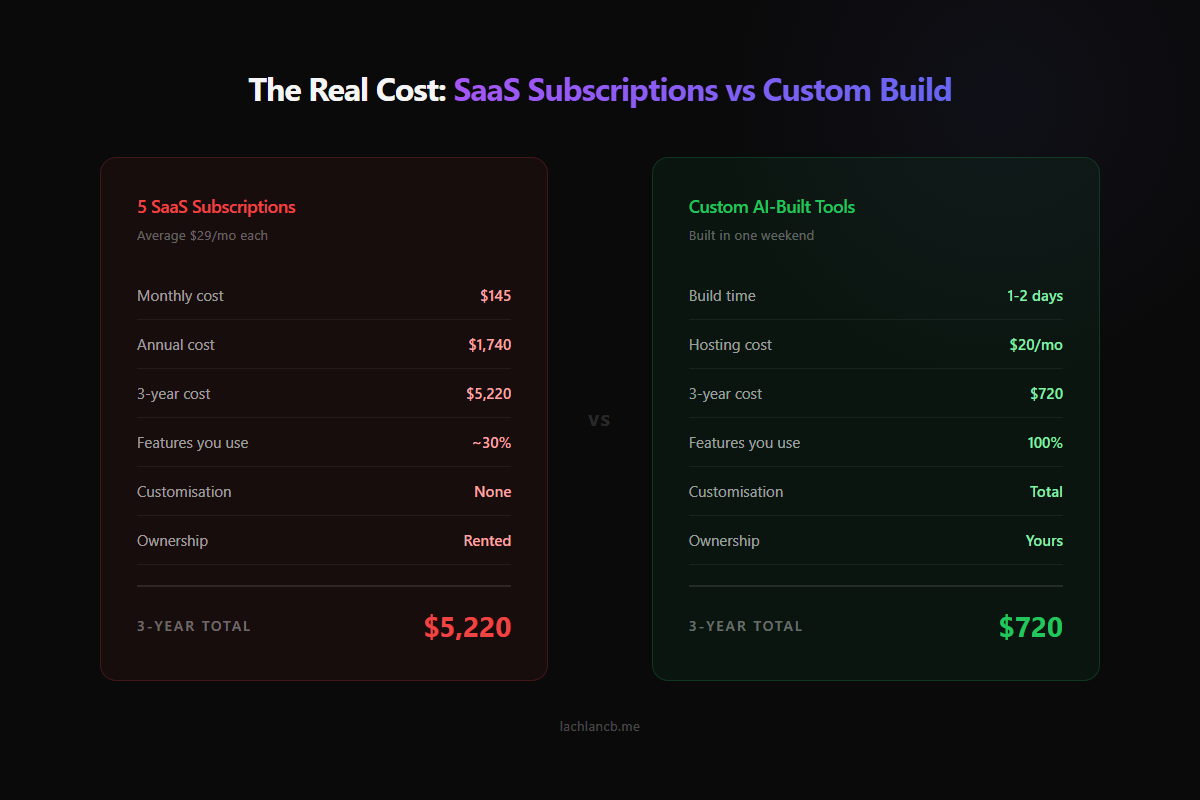
Now compare that to spending one weekend building custom versions. Your cost? Whatever your time is worth, plus maybe $20/month in hosting. You own the tool. You can modify it whenever you want. You're not locked into someone else's feature roadmap or pricing tiers.
The SaaS pricing model was built for a world where software was expensive to create. In that world, amortising development costs across thousands of subscribers made sense. But when development costs approach zero, the subscription model becomes pure margin extraction.
This isn't theoretical. I know people who've cancelled $200+/month in SaaS subscriptions and replaced everything with custom tools they built in under a week. The ROI is almost instant.
Why Custom Beats Generic — Every Time
Generic tools force you to adapt your workflow to the software. Custom tools adapt the software to your workflow.
Think about it. Every SaaS you've ever used has features you don't need and is missing features you do. You pay $29/month for a tool where you use maybe 30% of the functionality. The rest is built for someone else's use case.
When the cost of building something custom drops to near zero — and that's where AI work is heading — the math on subscriptions stops working. Why rent a generic tool when you can own a perfect one?
I wrote about this shift in The AI Website Just Killed the $5,000 Homepage. The same force that's compressing web design pricing is compressing SaaS pricing. When anyone can build it, no one can charge a premium for it.
What Still Has a Moat
Not all SaaS is dying. Let me be specific about what I mean.
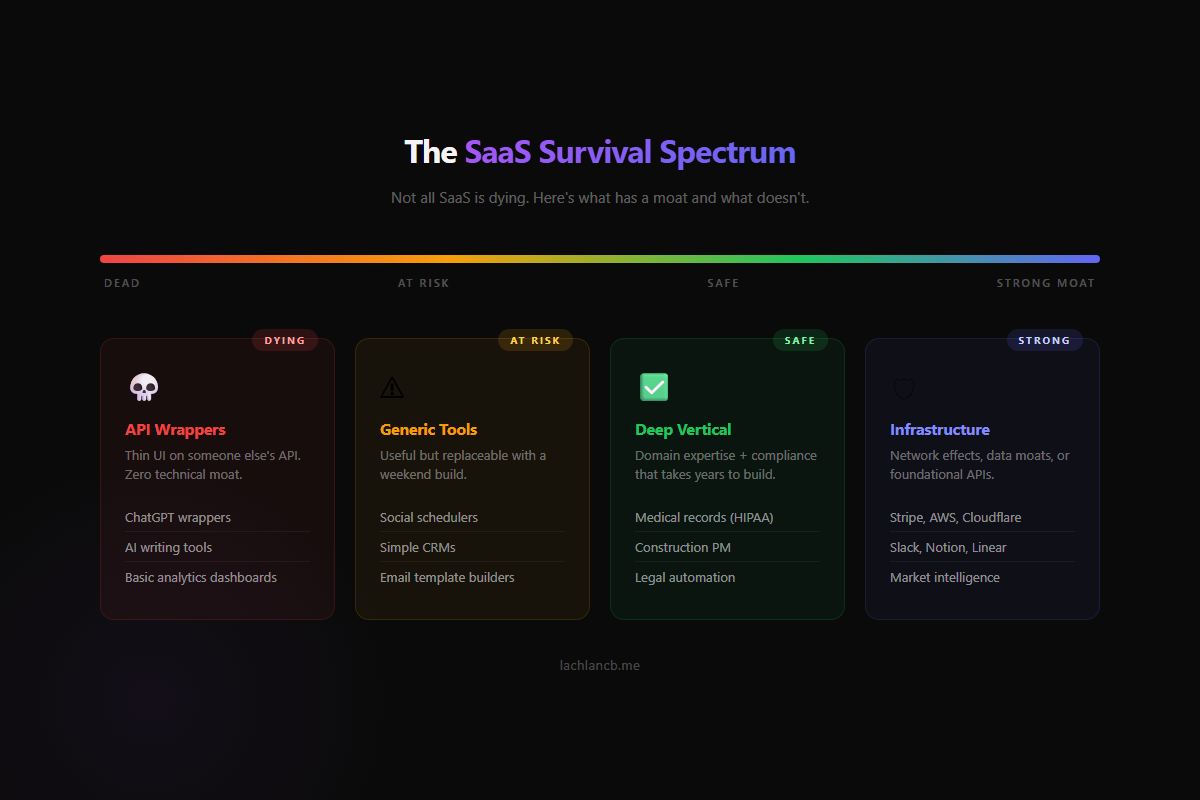
Infrastructure SaaS is fine. Stripe, Supabase, AWS, Cloudflare — these aren't wrappers. They're the foundations that everything else is built on. You're not going to spin up your own payment processor in an afternoon. These companies have real engineering moats: years of hardening, compliance certifications, global infrastructure.
Network-effect products are fine. Slack, Notion, Linear — their value comes from the people using them, not the code running them. You can't replicate a network. Even if you built a perfect Slack clone, it's worthless without your team on it.
Deep vertical expertise is fine. Medical records systems, construction project management, legal document automation — these require domain knowledge that goes beyond wrapping an API. The value is in understanding the workflow, the compliance requirements, the edge cases. That takes years to accumulate.
Data moats are fine. Products that get better the more people use them — recommendation engines, benchmarking tools, market intelligence platforms. Their data is the product, and you can't replicate that with a weekend build.
What's dying is the middle layer. The "I built a pretty interface on top of OpenAI's API and charge $19/month for it" model. That entire category is getting compressed to zero.
The One-Time Purchase Comeback
Here's where it gets interesting. I think there's still real money in selling software — but not on a subscription model.
One-time purchases are having a moment. People who want to buy something outright, own it, and not worry about another monthly charge eating their margins — those buyers have a lot of power right now. And the market is starting to reflect that.
Think templates, starter kits, pre-built automations, downloadable tools. Build once, sell infinitely. The economics work because there's no ongoing infrastructure cost when the buyer runs it themselves.
Look at what's working right now:
- Notion templates selling for $29-99 on Gumroad
- Next.js starter kits going for $199+ on indie marketplaces
- Automation workflow blueprints packaged as one-time downloads
- Claude Code skills and prompt libraries as digital products
These aren't subscriptions. They're assets. The buyer gets full ownership, the seller gets pure margin after the first sale. No servers to maintain, no customer support tickets about uptime, no feature request backlogs.
This is where I think the SaaS-in-a-wrapper crowd should pivot. Stop building subscription products that AI can replicate. Start building one-time purchase assets that save people time.
What SaaS Builders Should Do Instead
If you've been building a wrapper SaaS, don't panic. But do pivot — quickly.
Option 1: Go deeper. Pick a specific vertical and become the expert. Don't build "an AI writing tool." Build the AI writing tool for real estate agents that integrates with MLS listings and generates neighbourhood guides. The wrapper is still thin, but the domain knowledge is thick.
Option 2: Sell the outcome, not the tool. Instead of charging $29/month for access to your dashboard, charge $500 one-time for a fully configured system. Done-for-you beats do-it-yourself when the buyer's time is more valuable than the tool's price.
Option 3: Build infrastructure, not interfaces. If you're technical enough to build a SaaS, you're technical enough to build something that other developers need. APIs, SDKs, developer tools — these have real moats because they're embedded in other people's code.
Option 4: Package expertise as products. Your knowledge of the problem space is more valuable than the UI you built. Templates, courses, playbooks, consulting — these scale without servers.
What This Means for You
If you're building a SaaS right now, ask yourself one question: could someone recreate this with Claude Code in a weekend?
If the answer is yes, you don't have a product. You have a head start. And head starts in tech last about six months.
If you're subscribing to SaaS tools, ask yourself the same question. Every subscription you're paying for that's just a UI on top of an API is a candidate for replacement. Not tomorrow — today. The skills landscape has shifted, and the people who recognise it early will save thousands per year.
The wrapper era gave us a lot of convenient tools. But convenience is only worth paying for when the alternative is hard. The alternative isn't hard anymore.
Build your own tools. The bar has never been lower.

Related: Anyone Can Build Now. That's Why Selling Just Became Everything